Shaving Bumps and Ingrown Hairs in Men: Why They Happen and How Laser Breaks the Cycle

Shaving bumps have a proper clinical name: pseudofolliculitis barbae, or PFB. It happens when a cut hair curls back and re-enters the skin, and the body reacts to it the same way it would react to any foreign object under the skin, with inflammation that shows up as small red or flesh-coloured bumps, usually along the jawline and neck. DermNet puts the prevalence at roughly 45–80% of men of African ancestry, largely down to a higher rate of tightly curled, coarse hair, though it isn’t limited to one group. Any man who shaves close and often, with hair that’s coarse or curly enough, can end up with it.
Where laser fits in is fairly simple once you understand the mechanism. Fewer hairs regrowing means fewer hairs available to curl back into the skin, which is exactly why DermNet lists laser epilation using Nd:YAG as one of the recognised treatment routes, not as a cosmetic add-on but as a genuine clinical option. Most cases settle within 4–6 weeks of stopping whatever’s causing them, but for men who can’t or don’t want to stop shaving, that’s not much of a solution, which is the gap laser is actually built for.
What Are Shaving Bumps? The Real Medical Explanation
“Shaving bumps” is the everyday term for a condition dermatologists call pseudofolliculitis barbae, or PFB for short. You might also hear it called razor bumps, barber’s itch, or ingrown facial hair. According to DermNet, pseudofolliculitis barbae is a common inflammatory reaction of the hair follicle, most often on the face as a result of shaving, and it can also occur anywhere hair is shaved or plucked, including the armpit, groin, and legs.
It’s worth being precise about the difference between two conditions that look similar but aren’t the same thing. PFB is an inflammatory reaction caused by hair curling back into the skin. It isn’t an infection. Folliculitis barbae, a related but different condition, is caused by bacterial infection and can coexist with PFB, presenting similarly but with a different underlying cause. This matters because the treatment approach differs. PFB is fundamentally a mechanical problem caused by how the hair grows back, while folliculitis barbae needs to be addressed as an infection.
Why Do Shaving Bumps Happen? The Actual Mechanism
This is where most articles on this topic stay frustratingly vague, so here’s the real biology.
Razor bumps are caused by tightly curly hair, often coarse in nature, piercing back into the skin either by re-entering through the skin surface (transfollicular) or by curling back beneath the surface and piercing the follicular wall from underneath (intrafollicular). Both routes trigger the same result: your immune system treats the re-entered hair as a foreign object and mounts an inflammatory response around it, which is what produces the visible bump.
This is much more likely to happen with close shaving, because cutting hair at an angle right at the skin’s surface leaves a sharp, pointed tip that’s far more prone to curling back than a hair left with a little length. The condition is also more common with blade razors than electric shavers, because blades tend to cut hair closer and sharper.
The jawline is a particularly common site because hair follicles there grow in multiple directions rather than one consistent direction, which increases the likelihood of a cut hair curling back on itself as it regrows. That’s also the biological reason the neckline and beard-line area, where Alpha Laser Clinic’s beard line laser treatment is most commonly requested, is such a frequent trouble spot for exactly this problem.
Who Gets Shaving Bumps? The Real Numbers
According to DermNet, pseudofolliculitis barbae predominantly affects men of African ancestry, at a prevalence of approximately 45–80%, largely due to a greater prevalence of tightly curled, coarse hair in that population. A related clinical source (Medscape) puts this even higher for regular close shavers, noting that as many as 83% of adult Black men who shave closely on a regular basis experience PFB, with an estimated 5 million people in the US alone affected by severe cases.
There’s also a genetic component: a specific single nucleotide substitution in a hair follicle keratin gene (K6hf) has been identified as an additional risk factor.
But this isn’t exclusively a condition affecting one group. PFB can occur in men of any race. Coarse, curly hair of any kind increases the risk, and the closer and more frequently someone shaves, the higher the risk regardless of ethnicity. If you shave daily with a blade razor and notice bumps developing along your jaw or neck within a day or two, this is very likely what’s happening, whoever you are.

National Award Winner
Secured top 3 positions across 4 major categories at the Beauty & Aesthetics Awards 2025

Category of
Category of
best for laser award
Category of
best social media
Category of
entrepreneur of the year
Category of
best aesthetics practitioner
Category of
most wanted aesthetic clinic

Category of
RISING STAR
AWARd

Category of
best for laseR Award
Category of
Best Social
Media Award
Category of
Entrepreneur of the year
Category of
Best Aesthetics practitioner

Category of
Most Wanted Aesthetic Clinic
National Award Winner
Secured top 3 positions across 4 major categories at the Beauty & Aesthetics Awards 2025
Category of
RISING STAR
AWARd
Category of
best for laseR Award
Category of
Best Social
Media Award
Category of
Entrepreneur of the year
Category of
Best
Aesthetics practitioner
Category of
Most Wanted Aesthetic Clinic
Shaving Bumps vs Ingrown Hairs vs Folliculitis: What’s the Difference?
These terms get used interchangeably, which causes real confusion. Here’s the actual distinction:
Condition | Cause | Where it typically appears | Infectious? |
Pseudofolliculitis barbae (PFB) / shaving bumps | Cut hair re-entering the skin, mechanical | Jawline, neck, anywhere shaved close and often | No, inflammatory, not infectious |
Folliculitis barbae | Bacterial infection of the follicle | Same areas, can coexist with PFB | Yes |
Ingrown hair (general) | Same mechanism as PFB, but the umbrella term used for any body area | Beard, neck, but also chest, back, legs after shaving/waxing | No, but can become infected if picked at |
Razor burn | Surface irritation from the blade itself, not hair regrowth | Anywhere shaved, appears immediately | No |
Razor burn is a distinct, milder condition, usually transient surface redness and irritation with no infection involved, unlike PFB. If your skin is irritated immediately after shaving but clears within a day, that’s more likely razor burn. If bumps persist, recur in the same spots, or develop days after shaving, that’s the pattern typical of PFB.
What Are the Symptoms of Shaving Bumps in Men?
PFB presents as an acne-like eruption of ingrown hairs, showing as flesh-coloured or red follicular papules, most often on the face and neck after shaving. Specific features to look out for:
- Bumps that may be itchy or tender
- Lesions that can bleed when shaved over
- A condition that may coexist with, and be made worse by, eczema or dermatitis
- Once healed, the skin may be left with postinflammatory hyperpigmentation (darker patches) and in some cases, scarring
If left unaddressed and shaving continues in the same way, complications can include folliculitis barbae (secondary infection), abscess formation, and scarring, including keloid scarring in more severe or repeated cases. This is worth taking seriously rather than dismissing as a normal part of shaving. Persistent, repeated PFB genuinely can leave lasting marks on the skin.
How Is Pseudofolliculitis Barbae Normally Treated?
DermNet is clear that the safest and most definitive cure is to stop the causative hair removal method (usually shaving) entirely, and that the inflammatory response typically subsides 4–6 weeks after stopping. For a lot of men, in client-facing jobs, in industries with grooming standards, or who simply prefer being clean-shaven, that isn’t a realistic long-term answer.
Beyond stopping shaving altogether, the standard clinical approach includes several tiers:
General measures, which include shaving in the direction of hair growth rather than against it, not stretching the skin while shaving, using short strokes, using sharp blades, avoiding shaving the same area twice, and leaving roughly 1mm of stubble rather than shaving perfectly close. Switching from a blade razor to an electric shaver, and reducing shaving frequency to every other day, are also commonly recommended. Keeping the skin well moisturised, including with glycolic acid preparations that gently exfoliate, can also reduce the risk of new inflamed spots forming.
Specific medical measures, which a GP or dermatologist may prescribe for active flare-ups, include topical steroid creams and topical antimicrobials to reduce inflammation and itching, topical acne treatments to reduce follicular hyperkeratosis, and in some cases oral antibiotics to reduce inflammation. These are medical treatments for an active flare and outside what a laser clinic can prescribe. We’d always recommend seeing a GP or dermatologist if you have active, inflamed PFB that needs treating directly.
Alternative hair removal techniques. This is where laser hair removal comes in, and it’s listed as a legitimate clinical option: DermNet specifically names laser epilation using Nd:YAG as a treatment option for pseudofolliculitis barbae, alongside other approaches like chemical depilatories and photodynamic therapy.
How Does Laser Hair Removal Break the Shaving Bumps Cycle?
The logic here is straightforward once you understand the mechanism above: PFB happens because a cut hair regrows, gets cut again, and curls back into the skin. Every single regrowth cycle is another opportunity for that to happen. Laser hair removal doesn’t treat the inflammation directly. What it does is reduce the number of hairs that regrow in the treated area over a course of sessions, which means there are progressively fewer hairs available to curl back into the skin and cause the problem in the first place.
This is why laser is described as breaking the cycle rather than curing PFB outright. It’s an indirect but effective approach. Fewer hairs regrowing means fewer opportunities for the mechanical problem that causes PFB to occur.
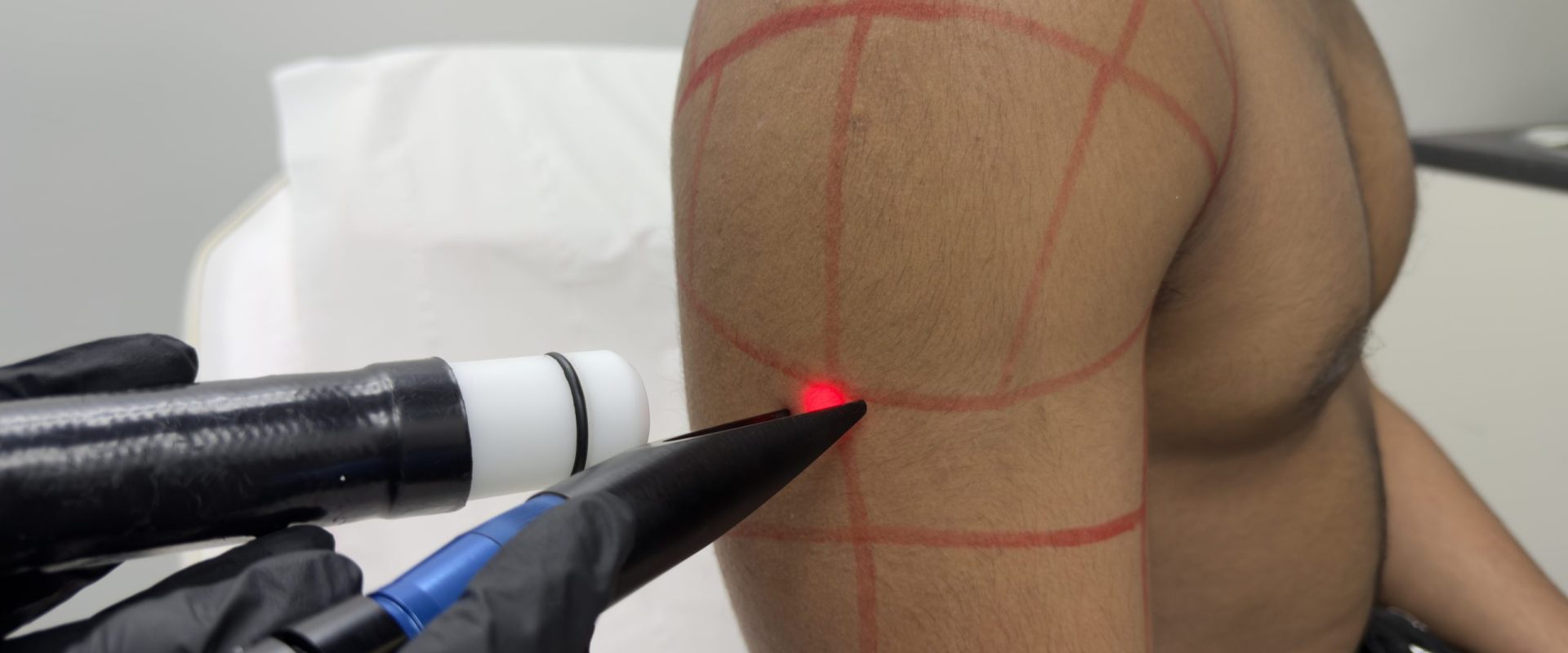
At Alpha Laser Clinic, we use medical-grade laser technology, including ND:YAG, for beard-line and neck treatment, the same laser type DermNet lists specifically for PFB, suited to coarser facial hair and a range of skin tones. This isn’t a coincidence. ND:YAG’s longer wavelength is generally well suited to the coarse, curly hair types most associated with PFB, and to a wider range of skin tones than some alternative laser types.
Shaving Bumps: What Happens Session by Session With Laser
Session 1. Hair in the treated area is targeted, but existing active PFB bumps won’t clear immediately. This is a gradual process tied to reduced regrowth, not an instant fix for current inflammation.
Sessions 2–3. As regrowth reduces and becomes finer, many men notice fewer new bumps forming, particularly in areas that were previously shaved daily.
Sessions 4–6. A meaningful reduction in the frequency and severity of new PFB flare-ups is typical by this stage, as fewer hairs are regrowing to cause the problem.
Sessions 7–8+. For men with particularly coarse, curly facial hair (the hair type most prone to PFB), additional sessions may be recommended to achieve the most stable, long-term reduction.
Throughout, existing active bumps and any skin discolouration from past flare-ups are a separate issue from the hair removal itself, and may benefit from the general and specific measures covered above, ideally discussed with a GP or dermatologist alongside your laser course.
Laser Hair Removal Services For Men In Bradford
Alpha Laser Clinic is Yorkshire’s first men’s only clinic specialising in men’s laser hair removal in Bradford and other cosmetic treatments for all skin tones.
Who Laser Treatment for Shaving Bumps Works Well For
- Men who experience recurring bumps, ingrown hairs, or irritation along the jawline, neck, or beard line specifically after shaving.
- Men with coarse, curly, or tightly curled facial or neck hair, the hair type most associated with PFB.
- Men who shave daily or near-daily for work or personal preference and can’t realistically stop shaving as a solution.
- Men who’ve already tried shaving technique changes (electric shaver, shaving with the grain, reduced frequency) and still experience regular flare-ups.
- Men with visible post-inflammatory dark patches from repeated past PFB who want to reduce the ongoing cause of new flare-ups.
Who Laser Treatment for Shaving Bumps Isn’t For
Men with active, currently inflamed PFB or a suspected skin infection. Actively inflamed skin, or skin that may be infected with folliculitis barbae, needs proper clinical assessment first, potentially by a GP or dermatologist, before laser treatment is appropriate. Your practitioner will check the treatment area at consultation and advise if this applies to you.
White, grey, red, or very light blonde facial or neck hair. Laser targets melanin (pigment) in hair. Without pigment, there’s nothing for the laser to target, regardless of how much of a problem the hair is causing. We’ll say so honestly at consultation.
Men expecting laser to clear existing scarring or hyperpigmentation. Laser hair removal reduces future hair regrowth. It doesn’t treat existing skin discolouration or scar tissue from past flare-ups. That’s a separate conversation, potentially with a dermatologist, about skin treatment options.
Recently tanned or sunburnt skin in the treatment area. This needs to settle before laser is appropriate, for safety reasons.
Men who want a guarantee that bumps will never return. Laser significantly reduces the mechanical cause of PFB by reducing hair regrowth, but it doesn’t offer a 100% guarantee, and results vary between individuals. Being honest about that matters more to us than overselling it.
Shaving Bumps: What You Can Do Right Now, Before or Alongside Laser
Based on DermNet’s general measures, small changes to your shaving routine can meaningfully reduce flare-ups even before or during a laser course:
- Shave in the direction the hair grows, not against it. Shaving against the grain gets a closer cut, but it’s also the single biggest contributor to hairs curling back into the skin.
- Don’t stretch your skin taut while shaving. It feels like it gives a closer shave, but a closer shave is exactly what increases PFB risk.
- Leave a small amount of stubble rather than shaving perfectly smooth. Roughly 1mm of length gives the hair less opportunity to curl back on itself.
- Switch to an electric shaver if you’re prone to bumps. It’s less precise than a blade but meaningfully reduces PFB risk for many men.
- Reduce shaving frequency where you can, every other day rather than daily. Fewer cuts to the same hairs means fewer opportunities for re-entry.
- Keep the area moisturised. Well-moisturised skin, and gentle exfoliation with glycolic acid where appropriate, can reduce new inflamed spots.
None of this replaces proper treatment for existing PFB, and if you have active, inflamed bumps, seeing a GP is the right first step, but these changes reduce the underlying mechanical risk regardless of what else you’re doing about it.
Shaving Bumps Mistakes Men Make
Shaving more often to try to “get on top of it.” This almost always makes PFB worse, not better. More frequent close shaving means more opportunities for cut hair to curl back into the skin.
Picking or squeezing bumps. This increases the risk of secondary infection (folliculitis barbae) and scarring, including keloid scarring in some cases.
Assuming it’s just acne and using acne treatments alone without addressing the shaving technique. Topical acne treatments can help reduce inflammation, but without changing the underlying shaving pattern causing the mechanical re-entry, new bumps will keep forming.
Waiting until scarring has developed before seeking help. Postinflammatory hyperpigmentation and scarring are listed complications of untreated, repeated PFB. Earlier intervention, whether through shaving changes, medical treatment, or laser, generally gives a better long-term outcome than waiting.
Assuming laser alone will fix active, inflamed skin immediately. Laser reduces future hair regrowth gradually over a course of sessions. It isn’t a treatment for currently active inflammation, which may need separate medical attention first.
Shaving Bumps Myths for Men
“It’s just acne.” It isn’t. PFB is a mechanical, hair-related condition, not primarily an oil-and-bacteria condition like acne, even though the bumps can look superficially similar. Treating it purely as acne without addressing the shaving pattern won’t solve the underlying cause.
“Only Black men get razor bumps.” While PFB predominantly affects men of African ancestry due to a higher prevalence of coarse, tightly curled hair, DermNet is explicit that it can occur in men of all races. Anyone with sufficiently coarse or curly hair who shaves close and often is at risk.
“There’s nothing you can do except stop shaving.” While stopping shaving is described as the safest and most definitive cure, DermNet lists multiple other general and specific measures, including laser epilation, as legitimate treatment routes for men who need or want to keep shaving-adjacent areas managed.
“Laser will make it worse before it gets better.” Laser reduces future hair regrowth progressively. It doesn’t cause new PFB. Any discomfort during a session is separate from the condition itself and is generally described as mild to moderate, similar to an elastic band snap.
Is Laser Treatment Worth It for Shaving Bumps?
For men with a genuine, recurring pattern of shaving bumps along the jaw, neck, or beard line, particularly those with coarse or curly facial hair, and particularly those who can’t realistically stop shaving as a long-term fix, laser hair removal is a legitimate, dermatology-recognised approach to reducing the underlying cause. It isn’t a direct treatment for active inflammation, and it won’t undo existing scarring or discolouration. What it does offer is a genuine, evidence-backed way to reduce how often the mechanical problem happens in the first place, by reducing how much hair regrows to cause it.
If you’re dealing with active, painful, or infected-looking bumps right now, our honest advice is to see a GP first. Laser is a longer-term prevention strategy, not an emergency treatment for skin that’s currently inflamed.
Shaving Bumps and Ingrown Hairs FAQ
Q1 What causes shaving bumps in men?
Shaving bumps, or pseudofolliculitis barbae, are caused by cut hair re-entering the skin, either piercing back through the surface or curling beneath it and piercing the follicle wall from underneath, which triggers an inflammatory reaction.
Q2 Are shaving bumps the same as ingrown hairs?
Broadly, yes. Pseudofolliculitis barbae is the clinical name for the specific pattern of ingrown facial hair caused by shaving, most often affecting the beard and neck area.
Q3 How long do shaving bumps take to heal?
According to DermNet, symptoms typically subside 4–6 weeks after stopping the causative hair removal method, most often shaving. For active, inflamed bumps, a GP or dermatologist can advise on medical treatment to speed this up.
Q4 Can laser hair removal cure shaving bumps completely?
Laser reduces the number of hairs regrowing in the treated area, which reduces the underlying mechanical cause of future bumps. DermNet lists laser epilation with Nd:YAG as a recognised treatment option. Results vary between individuals, and existing scarring or discolouration from past flare-ups isn’t treated by laser hair removal itself.
Q5 Do only Black men get shaving bumps? No. While PFB predominantly affects men of African ancestry, at a prevalence of roughly 45–80%, due to a higher rate of coarse, tightly curled hair, DermNet is clear that it can occur in men of any race, particularly those with curly or coarse facial hair who shave frequently and closely.
Q6 What’s the difference between razor burn and shaving bumps?
Razor burn is surface irritation from the blade itself, usually mild, transient redness with no infection involved. Shaving bumps (PFB) are caused by hair curling back into the skin, tend to persist or recur in the same spots, and can develop days after shaving rather than immediately.
Q7 Should I stop shaving if I have shaving bumps?
Stopping the causative hair removal method is described as the safest and most definitive cure, but DermNet acknowledges this isn’t realistic for many men for work, cultural, or personal reasons, which is exactly why alternative approaches, including changed shaving technique and laser hair removal, exist as practical options.
Q8 Can shaving bumps leave permanent marks?
Yes, in some cases. Postinflammatory hyperpigmentation and scarring, including keloid scarring, are listed complications of pseudofolliculitis barbae, particularly where flare-ups are repeated or picked at. This is a reason to address the underlying cause earlier rather than later.
Q9 Is laser hair removal for shaving bumps painful?
Most men describe the sensation as similar to an elastic band snap against the skin, generally manageable with modern cooling technology, not typically described as more uncomfortable than the condition it’s treating.
Q10 Will laser hair removal help with ingrown hairs on my neck specifically?
Often yes, particularly where collar friction aggravates the area. Fewer hairs regrowing generally means fewer opportunities for hair to curl back into the skin along the neckline, which is a common site for this exact problem.




