Chest Hair Removal for Men: What to Expect Before the Gym or Holiday Season

Chest laser hair removal uses medical-grade laser, including ND:YAG, to target hair follicles during their active growth phase, gradually reducing chest hair over a course of sessions rather than removing it in one go. A 2023 clinical study on trunk hair removal in men, using an 810nm diode laser across 4 sessions spaced 40 days apart, recorded an average hair reduction of 80.6% in the treated areas. Most men need 6–8 sessions spaced 4–6 weeks apart for the chest specifically, and timing matters more here than on almost any other area, because so many men book chest laser hair removal to be ready for something: a summer holiday, a competition, a season at the gym with their shirt off more often than not.
That timing question is worth answering properly before anything else. A full course, at 4–6 weeks between sessions, realistically takes 6 months or more from first session to final result. If you’re planning around a specific date, working backwards from that date, not forwards from when you feel like starting, is the difference between being ready and being disappointed.
What Is Chest Hair Removal With Laser, Exactly?
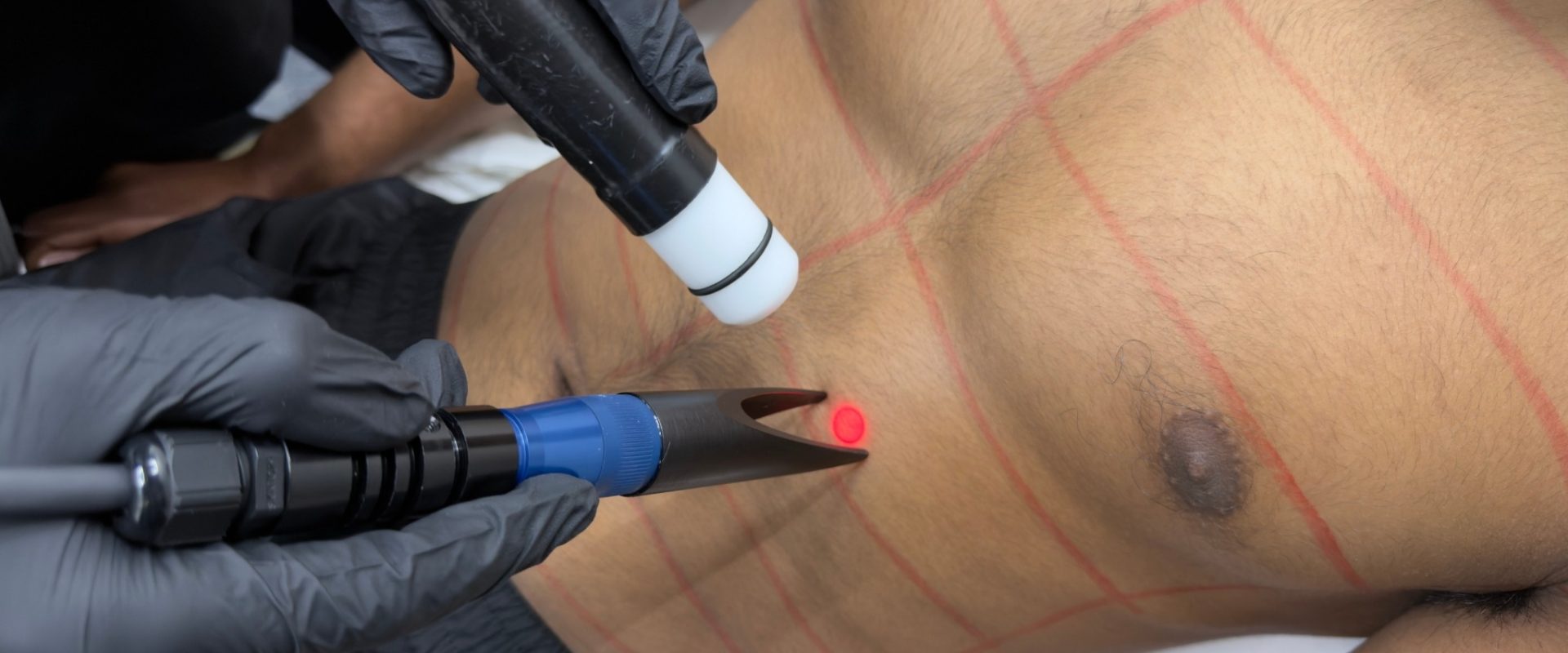
Laser hair removal for the chest works the same way it does everywhere else on the body: a concentrated beam of light, tuned to a wavelength absorbed by melanin (the pigment in hair), heats the hair follicle enough to damage its ability to keep producing hair. It’s applied across the chest from the collarbone down to beneath the pectoral muscles, including the areola area if needed, and a typical chest session takes around 20–30 minutes.
At Alpha Laser Clinic, chest treatment is carried out using medical-grade laser technology, including ND:YAG, which suits the coarser, denser hair growth common on the male chest. The chest is one of the most requested areas alongside the back, and for a lot of men it’s the area where hair growth is most visibly patchy, which is often as much of a motivation as density.
Why Chest Hair Removal Takes Multiple Sessions: The Mechanism
Hair on the chest, like hair everywhere else, cycles through three phases. In the anagen (growth) phase, the follicle is active and rich in pigment, which is the only time laser can effectively damage it. In the catagen (transition) phase, the follicle is shutting down and barely responds. In the telogen (resting) phase, the hair is dormant and invisible to the laser entirely.
At any given point, only around 20–30% of chest hair follicles are actually in the growth phase. The rest are resting or transitioning, completely unaffected by that day’s session. This is why sessions are spaced 4–6 weeks apart rather than back to back: it takes roughly that long for the next batch of dormant follicles to cycle into growth and become treatable. Compress the schedule and you’re not speeding up the result, you’re just re-treating hair that was already caught last time while missing the hair that’s cycled in since.
Chest Hair Removal: What Happens Session by Session
Session 1. Hair is treated across the chest, but there’s little visible change immediately. Treated hair sheds gradually over the following 1–3 weeks as the follicles release it.
Sessions 2–3. This is usually where men start noticing a real difference. Regrowth comes back visibly finer and patchier, and the density that made chest hair feel unmanageable starts to break up.
Sessions 4–6. Most men see a substantial reduction by this point. The 2023 diode laser study on men’s chest and back hair found average reductions around 80% by the end of a short course, though individual results vary with hair density, coarseness, and how consistently sessions are kept to schedule.
Sessions 7–8+. For particularly dense or coarse chest hair, further sessions may be recommended to get the most complete, stable result.
After the course. Occasional maintenance sessions, sometimes once or twice a year, are common to manage any regrowth, particularly where hair growth is hormonally driven. This is a normal part of how hair biology works and part of why no clinic should ever promise long-term hair reduction. Long-term hair reduction is the honest, defensible claim.

National Award Winner
Secured top 3 positions across 4 major categories at the Beauty & Aesthetics Awards 2025

Category of
Category of
best for laser award
Category of
best social media
Category of
entrepreneur of the year
Category of
best aesthetics practitioner
Category of
most wanted aesthetic clinic

Category of
RISING STAR
AWARd

Category of
best for laseR Award
Category of
Best Social
Media Award
Category of
Entrepreneur of the year
Category of
Best Aesthetics practitioner

Category of
Most Wanted Aesthetic Clinic
National Award Winner
Secured top 3 positions across 4 major categories at the Beauty & Aesthetics Awards 2025
Category of
RISING STAR
AWARd
Category of
best for laseR Award
Category of
Best Social
Media Award
Category of
Entrepreneur of the year
Category of
Best
Aesthetics practitioner
Category of
Most Wanted Aesthetic Clinic
Timing Chest Hair Removal Around a Holiday, Event, or Season
This is the part that trips a lot of men up, because chest hair removal is so often booked with a specific date in mind.
Work backwards from the date, not forwards from today. If you want visible results by a summer holiday, a wedding, or a competition, count back at least 6 months and start there. A 4–6 week gap between sessions across 6–8 sessions adds up quickly, and rushing the schedule to hit a deadline generally means fewer of your hair follicles get caught in their growth phase, not more.
Leave a gap between your final session and your event. Skin can be mildly red or sensitive for a short period after treatment, and needs to avoid direct sun exposure. Booking your last session with at least 1–2 weeks of buffer before you need to be poolside or on stage gives your skin time to settle.
Avoid tanning before and during your course. This applies whether you’re planning a holiday or not, but it matters even more if you are: sunbeds and self-tanners in the weeks before a session change how your skin absorbs the laser and can increase the risk of side effects. If you’re the sort of person who tans before a holiday to “prep,” that habit and a laser course don’t mix well, so plan one around the other rather than trying to run them side by side.
Gym and exercise timing matters too. Sweat and friction on freshly treated skin can cause irritation, so most clinics advise avoiding intense exercise for 24–72 hours after a session. If you train daily, this is worth factoring into which day of the week you book.
Chest Hair Removal Cost: The Real Comparison
UK chest laser hair removal typically runs somewhere in the range of £40–£90 per session depending on the clinic and area size, across a course of around 6–8 sessions. Set against that: if you shave or trim your chest weekly to keep on top of patchy or dense growth, that’s 50+ grooming sessions a year, indefinitely, plus the itch of regrowth and the general hassle of maintaining a look that never quite holds for more than a few days.
For exact, current pricing at Alpha Laser Clinic, see the Bradford laser prices or Oldham laser prices, and your practitioner will confirm the right plan for your chest and timeline at consultation.
Chest Hair Removal vs the Alternatives
|
Method |
How long results last |
Pain level |
Works on grey/blonde hair? |
Best for |
|
Shaving |
1–3 days |
Low, but razor burn and itch are common on the chest |
Yes |
Quick fix, constant upkeep |
|
Waxing |
2–4 weeks |
High over a large, sensitive area |
Yes |
Short-term smoothness |
|
Laser (ND:YAG/diode) |
Months to years, with occasional top-ups |
Moderate, often described as an elastic band snap |
No, needs pigment |
Men with dark, coarse chest hair wanting long-term reduction |
|
Electrolysis |
Can be permanent per treated follicle |
Moderate to high, slow for a large area |
Yes, the only method effective on grey/blonde hair |
Small areas or very light hair colours |
Who Chest Laser Hair Removal Works Well For
- Men with dark, coarse, or patchy chest hair who want a cleaner, more even look without shaving every few days.
- Men prepping for a specific date, holiday, competition, or event, provided the timeline is planned with enough lead time.
- Gym users and bodybuilders who want muscle definition to show through without hair obscuring it.
- Men with ingrown hairs or shaving-related irritation across the chest, since fewer regrown hairs generally means fewer chances for hair to curl back into the skin.
- Men who find waxing the chest too painful to repeat regularly, given how large and sensitive the area is.
Who Chest Laser Hair Removal Isn’t For
White, grey, red, or very light blonde chest hair. Laser targets melanin. Without pigment, there’s nothing for the laser to lock onto, and the treatment won’t produce a meaningful result regardless of how many sessions you have. We’ll say so honestly at consultation. Electrolysis is generally the more suitable route for very light or grey chest hair.
Men expecting results in time for an event booked less than a couple of months out. This is worth being direct about. A single session or two won’t deliver a visibly smoother chest for an event that’s imminent, because most of your hair simply won’t be in its growth phase yet. If your timeline is tight, we’d rather tell you what’s realistic than start a course that won’t be finished in time.
Recently tanned or sunburnt skin. Laser can’t safely be used on actively tanned or sunburnt skin, and your practitioner may ask you to wait before starting or continuing a course, which matters if you’re the type to tan before a trip.
Men with a genuine risk of increased hair growth after treatment (paradoxical hypertrichosis). This is rare, but it’s real, and it’s worth knowing about honestly rather than glossing over. See below.
Certain medications. Some medications increase photosensitivity, which can affect suitability. This is checked properly at consultation as part of your medical history.
Laser Hair Removal Services For Men In Bradford
Alpha Laser Clinic is Yorkshire’s first men’s only clinic specialising in men’s laser hair removal in Bradford and other cosmetic treatments for all skin tones.
A Real Risk Worth Knowing About: Paradoxical Hypertrichosis in Men
This is something almost no clinic mentions, and it’s worth covering honestly rather than pretending laser hair removal has zero downside.
In rare cases, laser hair removal can trigger the opposite of the intended effect: an increase in hair density, thickness, or darkness in or near the treated area, a condition called paradoxical hypertrichosis. It’s uncommon, generally reported at somewhere between 0.6% and 10% of cases across the wider literature, but a 2025 study published in the Journal of Cosmetic Dermatology (Moriguchi, 2025) found something worth knowing if you’re a man specifically: the study recorded a significantly higher rate of paradoxical hypertrichosis in male patients than female patients (33.3% vs 9.0% in that particular patient group), and importantly, the pattern was different too. In men, it was most often seen on the back, upper arms, and shoulders, areas of dense, androgen-driven hair growth, rather than the face and neck pattern more commonly reported in women.
The likely mechanism isn’t fully settled, but it’s thought to relate to under-treatment: if laser settings are too conservative for the area or skin type, the heat delivered to the follicle may be enough to stimulate growth rather than damage it, particularly in areas where fine, vellus hair sits alongside coarser terminal hair, which describes chest and back hair on a lot of men reasonably well. This is exactly why laser settings are adjusted individually to your hair and skin type at consultation, rather than using one fixed setting for everyone, and why an experienced practitioner working with medical-grade equipment matters. It’s a genuinely rare outcome, but a fair and honest one to flag before you start rather than after.
Chest Hair Removal Mistakes Men Make
Booking their first session a few weeks before a big event. As covered above, this almost never delivers the result men are hoping for. Start planning at least 6 months out if you have a specific date in mind.
Tanning before sessions to “look better” for a holiday. This works against the treatment rather than for it, and increases the risk of side effects.
Waxing or plucking chest hair between laser sessions. This removes the follicle laser needs to target. Shaving between sessions is fine.
Training hard immediately after a session. Sweat and friction on freshly treated skin can cause irritation. Most clinics recommend avoiding intense exercise for 24–72 hours afterwards.
Assuming density alone determines suitability. Patchy, uneven chest hair is just as suitable for laser as dense, uniform growth, provided the hair itself has enough pigment. Patchiness is often one of the biggest reasons men book in the first place.
Chest Hair Removal Myths for Men
“I need to wait until my hair is really thick to bother.” Not true, and if anything the opposite. Dark, coarse hair of any density responds well to laser. Patchy or uneven growth is one of the most common reasons men book chest laser hair removal.
“It’ll definitely be ready in time if I just book more sessions closer together.” No. Cramming sessions closer than 4–6 weeks apart doesn’t speed up the biology, it just re-treats hair that was already caught while missing whatever’s cycled into growth since. The honest fix for a tight timeline is starting earlier, not compressing the schedule.
“Laser hair removal has no real downsides.” Mostly true, but not entirely, and paradoxical hypertrichosis, while rare, is a real documented risk, particularly for men on the chest, back, and shoulders. A reputable clinic tells you this rather than pretending it doesn’t exist.
“Chest hair removal is basically the same treatment as back hair removal.” The mechanism is identical, but the chest is generally a faster, less painful session for most men since it’s a smaller, more visible area to work with, and men often see the patchy-growth benefit here more distinctly than on the back.
Is Chest Laser Hair Removal Worth It for Men?
For men with dark, coarse, or patchy chest hair who are tired of shaving every few days or have a genuine event to prepare for, chest laser hair removal is one of the more straightforward, well-evidenced applications of this treatment; the 80%+ reduction figures from clinical studies on men specifically back that up. The honest caveats are timing (start earlier than you think you need to) and the small but real risk of paradoxical hypertrichosis, which is worth knowing about rather than discovering after the fact. Get the timeline right and go in with realistic expectations, and it’s a genuinely useful treatment for the areas and reasons most men actually book it for.
Chest Hair Removal FAQ
Q1 How many sessions does chest hair removal take for men?
Most men need 6–8 sessions spaced 4–6 weeks apart, though very dense or coarse chest hair may need up to 8–10. A 2023 clinical study using an 810nm diode laser across 4 sessions on men’s chest and back hair recorded an average 80.6% reduction.
Q2 How far in advance should I start chest hair removal before a holiday?
At least 6 months, ideally longer. Work backwards from your travel date, allowing 4–6 weeks between each of 6–8 sessions, plus a buffer of 1–2 weeks after your final session before you need to be in the sun.
Q3 Does chest hair removal hurt?
Most men describe it as similar to an elastic band snapping against the skin. It’s generally considered easier to tolerate than waxing the same area, especially with modern cooling technology.
Q4 Can I exercise after a chest hair removal session?
It’s best to avoid intense exercise for 24–72 hours afterwards, since sweat and friction on freshly treated skin can cause irritation.
Q5 Will chest hair removal work on my grey or light blonde chest hair?
No. Laser targets melanin, and grey, white, and very light blonde hair contains little to none. We’ll say so honestly at consultation rather than start a course unlikely to work.
Q6 What is paradoxical hypertrichosis and should I be worried about it?
It’s a rare condition where laser treatment triggers increased hair growth rather than reduction, more commonly reported in men than women, particularly on the back, shoulders, and upper arms. It’s uncommon, but worth knowing about. Using correctly calibrated, medical-grade equipment and an experienced practitioner reduces this risk significantly.
Q7 Is chest hair removal safe for gym users and bodybuilders?
Yes, and it’s one of the most common reasons men book it. The main practical consideration is timing sessions around training, since intense exercise straight after a session isn’t advised.
Q8 Can I get patchy chest hair treated, or does it need to be dense first?
Patchy or uneven chest hair is just as suitable for laser as dense growth, provided the hair has enough pigment. Uneven growth is one of the most common reasons men come in.
Q9 How long does a chest hair removal session take?
Typically 20–30 minutes, depending on hair density and how much of the chest is being treated.
Q10 Is chest hair removal permanent?
No treatment can honestly promise long-term hair reduction. Chest laser hair removal gives long-term hair reduction, often significant, but most men need occasional maintenance sessions afterwards to manage any regrowth over time.
Get in touch with us.




