Beard Line Laser Shaping for Men: Get the Design Right First

Beard line laser hair removal uses medical-grade laser, including ND:YAG, to reduce hair growth outside a chosen beard shape, usually the cheeks, neck, and jawline edges, so the line stays sharp without shaving or trimming every day. Here’s the part that matters more than anything else on this page: because the reduction is long-term, the shape you draw before session one is the shape you’re committing to. Most men need 6–8 sessions spaced 4–6 weeks apart, and once an area is fully treated, hair generally won’t grow back there in any meaningful way. Redesigning the line later isn’t something you can just undo by growing it out again.
That’s why this treatment is worth treating less like booking a barber’s appointment and more like a decision you sit with for a few weeks first. Alpha Laser Clinic only treats facial and upper body areas, never below the jaw or neck to below-collar level, and suitability for your specific skin tone and hair colour is confirmed at consultation, not guessed at.
What Is Beard Line Laser Shaping?
Beard line laser shaping is the use of laser hair removal to define and maintain the edges of your beard (typically the cheek line, neck line, and jaw contour) so those boundaries stay sharp without needing a razor or trimmer every few days. Rather than removing the whole beard, it targets the hair growing outside the shape you want to keep, so what’s left inside the line continues to grow naturally while everything outside it gradually reduces and, in most cases, stops growing back in any meaningful way.
At Alpha Laser Clinic, this is done using medical-grade laser technology, including ND:YAG, suited to coarser facial hair and a range of skin tones. It’s one of the most requested treatments among our clients, and one of the most misunderstood, because most men come in thinking of it as “getting my line-up lasered” the way they’d think of a barber trim, when the biology behind it makes it a considerably bigger decision than that.
Why Beard Line Laser Is a Design Decision, Not Just a Treatment
This is the part almost nobody in this industry says plainly, and it’s the single most important thing to understand before booking: laser hair removal on the beard line is intended to reduce hair growth for the long term, in the exact shape you draw before you start.
That’s very different from shaving or trimming a line, where if you don’t like the shape, you simply let it grow back and try again tomorrow. With laser, once an area has been fully treated across a full course, hair in that zone typically won’t return in any significant way. If your neckline was drawn too high, or your cheek line too aggressive, you can’t “regrow” it back to where it was before. You’d potentially be looking at a beard transplant to restore hair to an area that’s been fully lasered, which is a completely different order of treatment.
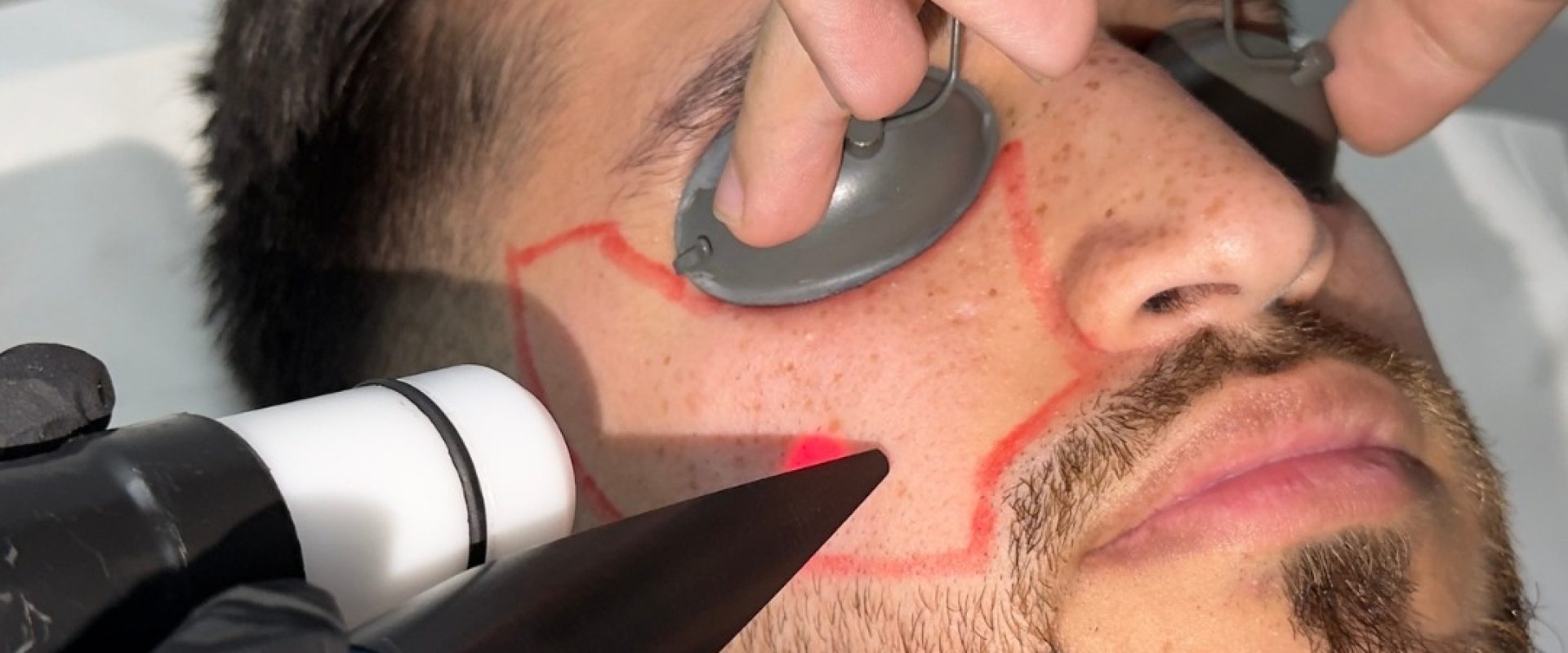
This isn’t meant to put you off. It’s meant to make sure you go into your first session with your eyes open, because it’s the single biggest source of regret we hear about from men who had beard line laser done somewhere that didn’t take the time to properly map the shape first. A good practitioner will mark the line with you, talk it through, photograph it, and confirm it with you before the laser is ever switched on, and will revisit that shape at your review sessions as treatment progresses, since early sessions won’t show the full picture yet.
The practical takeaway: think of your first session less like a haircut and more like a tattoo consultation. Decide the shape you actually want to live with, not just the shape that looks good this month.
How Beard Line Laser Actually Works: The Mechanism
Laser hair removal targets melanin, the pigment in hair, using a concentrated wavelength of light. When the light hits a hair follicle in its active growth phase, it converts to heat, damaging the follicle’s ability to produce hair effectively. Do this consistently across the treatment area, over enough sessions, and hair growth reduces substantially and, for most men, stays that way long term.
Facial and neck hair, like hair everywhere else on the body, grows in cycles:
- Anagen (growth phase): the only phase where hair is vulnerable to laser, because the follicle is active and pigment-rich.
- Catagen (transition phase): the follicle is shutting down; laser has minimal effect.
- Telogen (resting phase): dormant, invisible to the laser until it cycles back into growth.
At any point, only a portion of your facial hair follicles are in the anagen phase. That’s why a single session never fully defines a beard line. It only catches whatever’s actively growing that day. Sessions are spaced 4–6 weeks apart specifically to catch the next wave of follicles as they cycle into growth, which is also why rushing the schedule doesn’t get you a sharper line any faster.

National Award Winner
Secured top 3 positions across 4 major categories at the Beauty & Aesthetics Awards 2025

Category of
Category of
best for laser award
Category of
best social media
Category of
entrepreneur of the year
Category of
best aesthetics practitioner
Category of
most wanted aesthetic clinic

Category of
RISING STAR
AWARd

Category of
best for laseR Award
Category of
Best Social
Media Award
Category of
Entrepreneur of the year
Category of
Best Aesthetics practitioner

Category of
Most Wanted Aesthetic Clinic
National Award Winner
Secured top 3 positions across 4 major categories at the Beauty & Aesthetics Awards 2025
Category of
RISING STAR
AWARd
Category of
best for laseR Award
Category of
Best Social
Media Award
Category of
Entrepreneur of the year
Category of
Best
Aesthetics practitioner
Category of
Most Wanted Aesthetic Clinic
The Skin Type and Hair Colour Matrix: What Determines Whether Beard Line Laser Will Work for You
This is the table almost no clinic publishes properly, and it’s the single most useful thing you can know before booking. Laser selection isn’t one-size-fits-all. The right wavelength depends on your Fitzpatrick skin type (a standard dermatology scale from I, very fair, to VI, deeply pigmented) and your hair colour and coarseness.
|
Fitzpatrick skin type |
Typical description |
Recommended laser wavelength |
Facial/beard hair suitability |
Key precaution |
|
I–II |
Very fair to fair, burns easily, rarely tans |
Alexandrite or diode generally effective |
Excellent on dark, coarse hair; poor on blonde/grey/red |
Lower risk of pigment-related side effects at this end of the scale |
|
III–IV |
Light-medium to olive, tans gradually |
Diode (810nm) commonly used; ND:YAG also suitable |
Good to very good on dark, coarse hair |
Requires correctly calibrated settings to balance efficacy and safety |
|
V |
Brown to dark brown |
ND:YAG (1064nm) generally preferred |
Good on dark, coarse hair with the right wavelength |
Higher risk of pigment-related side effects if the wrong wavelength or settings are used |
|
VI |
Deeply pigmented |
ND:YAG (1064nm) considered the safer standard |
Good on dark, coarse hair when treated correctly |
ND:YAG’s longer wavelength bypasses more surface melanin, reducing burn risk compared with shorter-wavelength lasers |
The reason ND:YAG is used so widely for darker skin tones and coarse male facial hair is straightforward physics: longer wavelengths penetrate deeper and are absorbed less by the melanin sitting in the surface of the skin, meaning more of the laser’s energy reaches the hair follicle itself rather than the skin around it. That reduces the risk of pigment-related side effects like burns or patches of lighter or darker skin, which is a genuine risk with the wrong laser choice on darker skin types.
None of this replaces a proper consultation. This table shows you why the conversation about skin type and hair colour matters. The actual laser settings and suitability decision for your skin are made by your practitioner, not from a blog post.
Beard Line Laser: What Happens Session by Session
Session 1. The shape is agreed, marked, and photographed with your practitioner. Hair is treated across the marked area, but visible change is minimal immediately. Hair sheds gradually over the following 1–3 weeks.
Sessions 2–3. The edge of the line typically starts looking cleaner between shaves, with less stray regrowth outside the marked boundary.
Sessions 4–6. Most men see a stable, well-defined line by this point, with significantly less need for daily touch-ups outside the shape.
Sessions 7–8+. For particularly coarse or dense facial hair, further sessions may be recommended to fully stabilise the line. Your practitioner reviews progress with you throughout. This isn’t a fixed script; it’s adjusted to how your hair is actually responding.
Ongoing. Occasional maintenance sessions, sometimes once or twice a year, are common to manage any regrowth, and hormonally-driven facial hair in particular can bring some hair back over time even after a full course.
Who Beard Line Laser Shaping Works Well For
- Men who shave or trim their neckline and cheek line every day or every few days and want that maintenance reduced long term.
- Men with coarse, dense, dark facial hair prone to defining a sharp line but constantly fighting stray regrowth between shaves.
- Men who suffer from razor bumps or ingrown hairs specifically along the neckline, where friction from collars makes the problem worse. Fewer regrown hairs generally means fewer opportunities for ingrown hair to form.
- Men who already know, and are confident in, the shape of the line they want. This treatment suits decisiveness, not experimentation.
- Men attending regular grooming appointments who are tired of the upkeep between visits.
Who Beard Line Laser Shaping Isn’t For
Men who aren’t sure what shape they want yet. This is the single most important exclusion. If you’re still experimenting with your beard shape month to month, laser isn’t the right treatment yet. Book a consultation to talk it through, but be honest with yourself about whether you’re ready to commit to a line for good.
White, grey, red, or very light blonde facial hair. Laser targets melanin. Without pigment in the hair, there’s nothing for the laser to lock onto, and the treatment won’t produce a meaningful result. We’ll tell you this honestly at consultation rather than start sessions unlikely to work. Electrolysis, which treats each follicle individually rather than relying on pigment, is typically the more suitable route for very light or grey facial hair.
Recently tanned or sunburnt skin on the face or neck. Laser can’t safely be used on actively tanned skin, and your practitioner may ask you to wait before treatment.
Certain medications. Photosensitising medications can affect suitability for facial laser treatment. This is checked as part of your medical history at consultation.
Men expecting a completely maintenance-free beard forever. Laser dramatically reduces the need for daily shaving outside your line, but most men still need occasional touch-ups and, over time, maintenance sessions. Results vary between individuals, and no reputable clinic should promise otherwise.
Laser Hair Removal Services For Men In Bradford
Alpha Laser Clinic is Yorkshire’s first men’s only clinic specialising in men’s laser hair removal in Bradford and other cosmetic treatments for all skin tones.
Beard Line Laser Cost: The Real Comparison
UK facial and beard line laser treatment typically runs somewhere in the range of £30–£70 per session depending on the clinic and area size, across a course of around 6–8 sessions. Set against that: if you shave your neckline and cheek line daily, that’s 350+ shaving events a year, indefinitely, plus the cost of blades, creams, and the odd nick or patch of irritation that comes with shaving the same tight lines every single day.
Laser doesn’t remove the need for a trimmer entirely (inside the beard, hair still grows and needs styling as normal), but it takes the outside-the-line maintenance from a daily task to, eventually, an occasional one. For exact current pricing, see the Bradford laser prices or Oldham laser prices pages, and your practitioner will confirm the right plan for your specific line and hair type at consultation.
Beard Line Laser vs the Alternatives
|
Method |
How long the line stays defined |
Pain level |
Works on grey/blonde hair? |
Best for |
|
Daily shaving/trimming |
Hours to a day |
Low, but nicks and irritation common along tight lines |
Yes |
Flexibility to change the shape whenever you like |
|
Waxing/threading the line |
1–3 weeks |
Moderate to high on sensitive facial skin |
Yes |
Short-term definition, not a long-term fix |
|
Laser (ND:YAG/diode) |
Months to years, with occasional maintenance |
Moderate, often described as an elastic band snap |
No, needs pigment |
Men who know their shape and want less daily maintenance |
|
Electrolysis |
Can be permanent per treated follicle |
Moderate to high, slower per session |
Yes, the only method effective on grey/white hair |
Men with light or grey facial hair, or fine detail work |
The honest trade-off: laser wins decisively on long-term maintenance if your hair colour suits it and you’re certain of your shape. Daily shaving wins on flexibility if you’re still deciding what you want. There’s no shame in choosing to wait. A rushed shape decision is about the only mistake in this treatment you can’t easily walk back.
What Happens Before Your Treatment?
Before any beard line laser session, your practitioner will assess your skin type, hair type, and relevant medical history, and will map and photograph the exact shape you want with you. A patch test may be required before your first session to check how your skin responds. This step matters more here than almost anywhere else on the body, precisely because the result is long-term. Getting the shape and the suitability check right before you start protects you from a decision you can’t easily undo.
Beard Line Laser Mistakes Men Make
Booking before finalising the shape. The single biggest mistake in this treatment. Take the time (weeks, not minutes) to decide on your line before your first session, ideally with reference photos of the exact shape you want.
Assuming it works the same as a barber’s line-up. A barber’s edge-up is temporary and adjustable week to week. Laser is the opposite. It’s the treatment specifically because it’s long-lasting, which is exactly why the shape decision matters so much more here.
Not accounting for how facial hair patterns change with age. Hairlines and beard growth patterns can shift over years. It’s worth discussing with your practitioner whether the line you want now is one that will still suit your face in five or ten years, particularly around the cheek line.
Plucking or waxing stray hairs between sessions. This removes the follicle laser needs to target. Shaving inside the line, and outside it if regrowth appears between sessions, is fine.
Turning up tanned. Recently tanned or sunburnt facial skin isn’t suitable for laser that day. Tell your practitioner if you’ve had recent sun exposure.
Beard Line Laser Myths for Men
“It’ll look exactly like a fresh line-up straight away.” Not from session one. Hair sheds gradually and the edge sharpens progressively across the course. The crisp, low-maintenance line most men picture typically shows up from session 4 onwards, not session 1.
“If I don’t like it, I can just grow it back.” This is the myth that matters most. Once an area is fully treated, hair in that zone generally won’t grow back in any meaningful way. This is why the shape has to be right before you commit, not something to “try and see.”
“It works the same regardless of my skin tone.” It doesn’t. Wavelength choice (diode vs ND:YAG, for example) changes both safety and effectiveness depending on your Fitzpatrick skin type, which is exactly why this is assessed individually rather than applying one setting to everyone.
“Grey hairs in my beard will just take a bit longer to treat.” No. Grey, white, and very light blonde hairs won’t respond to laser at all, regardless of how many sessions you have, because the laser has no pigment to target.
Is Beard Line Laser Shaping Worth It for Men?
For men who already know the shape they want and are tired of maintaining it every single day, beard line laser is one of the more useful applications of this technology in the whole clinic. The daily maintenance saving is real, and it shows up in a very visible, everyday way. The trade-off is real too. Go in undecided about your shape, and you risk a result you’re stuck with rather than one you’re pleased with, so this isn’t a treatment worth trying tentatively.
Our honest advice, and what we tell clients at consultation: if you’re not sure about your line yet, wait. Come back when you are. We’d rather have that conversation before you start than after your fourth session.
Beard Line Laser FAQ
Q1 How many sessions does beard line laser take?
Most men need 6–8 sessions spaced 4–6 weeks apart to reach a stable, well-defined result, though this varies with hair density and how your hair responds through the course.
Q2 Is beard line laser permanent?
No treatment can honestly promise long-term hair reduction. Beard line laser gives long-term hair reduction in the treated zone, and most men need only occasional maintenance sessions afterwards, but “long-term” and “permanent” aren’t the same claim, and we won’t use the second one.
Q3 Can I change my beard line shape after having it lasered?
Once an area is fully treated across a complete course, hair typically won’t grow back there in any meaningful way, so the shape becomes difficult to reverse without more involved procedures like a beard transplant. This is exactly why deciding the shape carefully before you start matters so much.
Q4 Does beard line laser hurt more than other areas?
Facial and neck skin can be more sensitive than the body in places, but most men describe the sensation as similar to an elastic band snap, manageable with modern cooling technology. Some areas, like directly over the jawbone, may feel more noticeable than others.
Q5 Will beard line laser work on my grey hairs?
No. Laser targets melanin (pigment), and grey, white, and very light blonde hair has little to none. If this applies to parts of your beard line, we’ll say so honestly at consultation.
Q6 What laser is used for beard line hair removal on darker skin?
ND:YAG (1064nm) is generally considered the safer wavelength for darker Fitzpatrick skin types, because its longer wavelength penetrates deeper while being absorbed less by melanin in the surface of the skin, reducing the risk of pigment-related side effects. The exact laser and settings are decided at consultation based on your individual skin and hair type.
Q7 Can beard line laser help with ingrown hairs along my neckline?
Often, yes. Fewer regrown hairs generally means fewer chances for hair to curl back into the skin, which is a common cause of ingrown hairs and irritation along the neckline, particularly where collars cause friction.
Q8 How do I decide on my beard line shape before treatment?
Take time (ideally weeks, not days) with reference photos of the shape you want. Your practitioner will map and photograph the line with you at consultation and again before your first session, and will talk through how your particular jaw and cheek structure will look with that shape.
Q9 What happens if my facial hair pattern changes as I get older?
This is worth discussing at consultation. Facial hair growth patterns can shift with age, and your practitioner can talk through how a line drawn today is likely to sit with your face in future years before you commit.
Get in touch with us.




