Chest Laser Hair Removal for Men
Chest Laser Hair Removal for Men In Bradford & Oldham
Chest laser hair removal for men uses medical-grade ND:YAG laser technology to target hair follicles across the chest, reducing regrowth over a course of sessions so shaving and waxing become far less frequent. Every course at Alpha Laser Clinic starts with a consultation and patch test so the practitioner can check skin type, hair type and suitability before treatment begins. Results are long term hair reduction, not permanent removal, and outcomes vary between individuals.
EXCELLENTTrustindex verifies that the original source of the review is Google. Best place to get laser. Not only do they make you comfortable but they always meet your needs. Best customer service I’ve ever had and will definitely be getting more treatmentsPosted onTrustindex verifies that the original source of the review is Google. I wanted to share my experience because it might help someone else make the right choice. Before coming to Alpha Laser Clinic in Bradford, I actually tried a place in my own local area. Unfortunately, after a few sessions I saw no real results at all, and to make things worse, I ended up with burns on my skin which was really disappointing. I was then recommended to try Alpha by my wife’s laser clinic, and honestly, I’m so glad I listened. After just ONE session here—using a very similar machine—I noticed a massive difference straight away. It really opened my eyes to the fact that it’s not just about the machine, the technician’s skill and experience make all the difference. The team here clearly know what they’re doing, they made me feel comfortable, and the results speak for themselves. I wish I had come here from the start. Highly recommend Alpha Laser Clinic if you’re serious about getting proper results.Posted onTrustindex verifies that the original source of the review is Google. 10/10 can’t complain, the brother was amazing really professional and talked me through the process and how to maintain a good healthy skin. Inshallah will be deffo coming back!Posted onTrustindex verifies that the original source of the review is Google. Brilliant service by AC. First time ever doing this made it very comfortable and eased the stress highly recommend!Posted onTrustindex verifies that the original source of the review is Google. Amazing experience from start to finish. From my initial patch test through to my third session, everything has been smooth and professional. The service itself has been 10/10, and I’ve seen excellent results from my first session. Highly recommendPosted onTrustindex verifies that the original source of the review is Google. I’ve had four sessions with alpha laser clinic and the results have been brilliant! Top customer service had my sessions with AC, Hammad and Saif have made me feel welcomed and comfortable during the session. The treatment is game changer I will definitely be doing more sessions seeing fantastic results. Top lads!Posted onTrustindex verifies that the original source of the review is Google. Been a regular customer here since 2024 and honestly hands down customer service and the work has beeen 11/10 these guys genuinely treat you like family rather than customers 1 of the workers made a very kind gesture at my most recent appointment as he knew I was in a dilemma and honestly restored my faith in humanity! Top lads keep up the good work can’t recommend this place enough ❤️Posted onTrustindex verifies that the original source of the review is Google. Hamad did a great job on my teeth. Nice experience. Very professionally executed in a clean and serene environment.Posted onTrustindex verifies that the original source of the review is Google. Amazing customer service and well respected staff members, best in the game without a doubt, highly recommendPosted onTrustindex verifies that the original source of the review is Google. Really good experience at Alpha Laser Clinic Bradford. My appointment was right on time, even though it was out of hours during Ramadan, which I really appreciated. Everything was super quick — in and out with no waiting around. The staff were really friendly and made me feel comfortable the whole time. Customer service was spot on. The place was clean and well organised too. Would definitely recommend!
What Is Chest Laser Hair Removal?
Chest laser hair removal uses a concentrated beam of laser light to target the pigment (melanin) inside each hair follicle, damaging it enough to slow or stop growth in that follicle’s cycle. It matters for the chest specifically because this is one of the most visibly maintained areas on the male body. Chest hair shows through t-shirts, open collars and gym kit, so stubble from shaving is noticeable within a day or two, not a week.
Alpha Laser Clinic uses ND:YAG laser technology (1064nm wavelength), well suited to coarser, darker chest hair and gentler on melanin-rich skin than older IPL or alexandrite systems. Chest hair is often thicker and more densely packed than neck or beard-line hair, and the area covers a broad surface with variable skin tone across the sternum, pectorals and collarbone.
Why Choose Chest Laser Hair Removal Over Shaving or Waxing?
Shaving the chest causes itching, razor rash and stubble visible again within a day or two, because a razor only cuts hair at skin level. Waxing lasts longer but the chest is widely reported as one of the more painful areas to wax, given hair density and skin sensitivity over the sternum. Both methods commonly cause ingrown hairs, particularly where hair curls back into the follicle after cutting or pulling.
Chest laser hair removal works differently. Rather than cutting or pulling hair, it targets the follicle itself, so over a full course regrowth becomes finer, patchier and slower to reappear. It changes the routine from “every day or two” to “an occasional trim, if anything.”
Chest Hair Removal Methods Compared
| Method | Effectiveness on chest | Pain level | Frequency needed | Irritation risk |
|---|---|---|---|---|
| Shaving | Temporary, skin-level cut | Low, razor burn common | Every 1 to 2 days | High |
| Waxing | Root removal, lasts 2 to 4 weeks | High, sensitive area | Every 3 to 4 weeks | Moderate to high |
| Hair removal cream | Surface dissolve | Low | Every 3 to 7 days | Moderate, chemical irritation |
| Electrolysis | Follicle by follicle, only true permanent method | Moderate to high, slow | Impractical for a full chest | Low to moderate |
| ND:YAG laser | Long term reduction, whole chest per session | Warm snap, cooling used | 6 to 8+ sessions, then top-ups | Low, mild redness typical |
Electrolysis is worth naming honestly. It is the only method that is genuinely permanent and the only one that works on white or grey hair, but treating a full chest follicle by follicle is slow and impractical, which is why laser is the more realistic option for larger areas.
Is Chest Laser Hair Removal Safe for Darker Skin?
Skin tone is assessed using the Fitzpatrick scale, running from type I (very fair, always burns) to type VI (deeply pigmented, never burns). Older laser and IPL systems targeted melanin in a way that could also affect surrounding skin pigment on darker tones, risking burns or patchy hyperpigmentation on the chest, where tone can vary across the area.
ND:YAG at 1064nm passes more deeply through skin and is less absorbed by surface melanin, which is why it is generally considered safer for Fitzpatrick IV to VI skin. This does not mean every darker skin tone is automatically suitable. It still depends on hair colour, density, recent tanning, and a practitioner assessment at consultation and patch testing.
Chest Hair and Skin Type Suitability Matrix
| Fitzpatrick skin type | Description | Suitability | Chest treatment notes |
|---|---|---|---|
| I to II | Very fair, burns easily | Good, standard settings | Dark, coarse chest hair responds best |
| III to IV | Light to moderate brown | Good with ND:YAG | Common on chest clients, calibrated at consultation |
| V to VI | Brown to deeply pigmented | Suitable with ND:YAG at correct settings | Needs an experienced practitioner, not alexandrite/IPL |
| Any type, white/grey/red/very blonde hair | N/A | Not suitable, no melanin to target | Electrolysis is the only realistic route |
That last row matters and most clinics avoid saying it plainly. Laser has nothing to target in hair with little or no pigment. If your chest hair is white, grey, very light blonde or red, a practitioner should say so at consultation rather than start a course that will not work.
How Many Chest Laser Hair Removal Sessions Do You Need?
Hair grows in cycles: anagen (active growth), catagen (transition) and telogen (resting). Laser can only effectively treat hair in the anagen phase, and at any one time only a portion of your chest hair is in that phase. This is why a single session cannot clear a chest, and why a course is spread out rather than done all at once.
A typical chest course runs to roughly 6 to 8 sessions, spaced 4 to 6 weeks apart, so the next round of follicles has cycled into active growth before each session. Worked out on a calendar, that is a course of approximately 6 to 10 months, followed by occasional top-up sessions. Coarse, dense chest hair typically needs more sessions in total than finer neck or shoulder hair, simply because there is more follicle density to work through cycle by cycle.
Who Chooses Chest Laser Hair Removal?
Gym-goers and athletes. Men who train regularly want a cleaner look under vests and fitted training tops, and less maintenance around lifting straps or heart rate monitors that catch on longer chest hair.
Swimmers. Reduced chest hair means less post-swim itching from chlorine on freshly shaved skin, a common complaint among men who shave before swimming.
Men who shave regularly and get irritation. If you are shaving your chest every few days and dealing with razor rash, red bumps or ingrown hairs along the sternum, this is one of the most common reasons men book a consultation.
Men wanting a cleaner, more defined look. Some men feel self-conscious about thick or patchy chest hair showing through open-collar shirts, and want a more even, groomed appearance without the daily upkeep.
Who Should Think Twice Before Booking Chest Laser Hair Removal?
Laser hair removal is not the right fit for everyone, and an honest practitioner will say so before taking payment.
- Very light, grey, white or red chest hair. Laser has no pigment to target, so results will be poor to non-existent.
- Recent sun exposure or fake tan. Active tan increases the risk of burns and pigmentation changes, so sessions may need postponing.
- Certain medications or skin conditions. Photosensitising medication (some acne treatments, antibiotics), active infections, or open lesions on the chest can rule out treatment until resolved.
- Unrealistic expectations of permanence. Laser gives long term hair reduction, not permanent removal, and some fine regrowth is normal over time.
- Patchy or hormonally driven regrowth. Some chest hair growth is hormonally influenced and laser will not fully resolve this, worth discussing honestly at consultation.
What Happens Before Your Chest Laser Hair Removal Session?
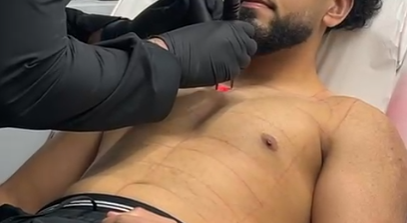
Before any chest laser hair removal session, a practitioner at Alpha Laser Clinic will assess your skin type, hair type, chest treatment area and relevant medical history. A patch test is carried out first so the practitioner can see how your skin responds and confirm the settings are appropriate before a full session goes ahead. This process is explained in full on the consultation, patch test and aftercare page, and it is not skipped or rushed, even for clients who have had laser treatment elsewhere before.
What Does Chest Laser Hair Removal Feel Like?
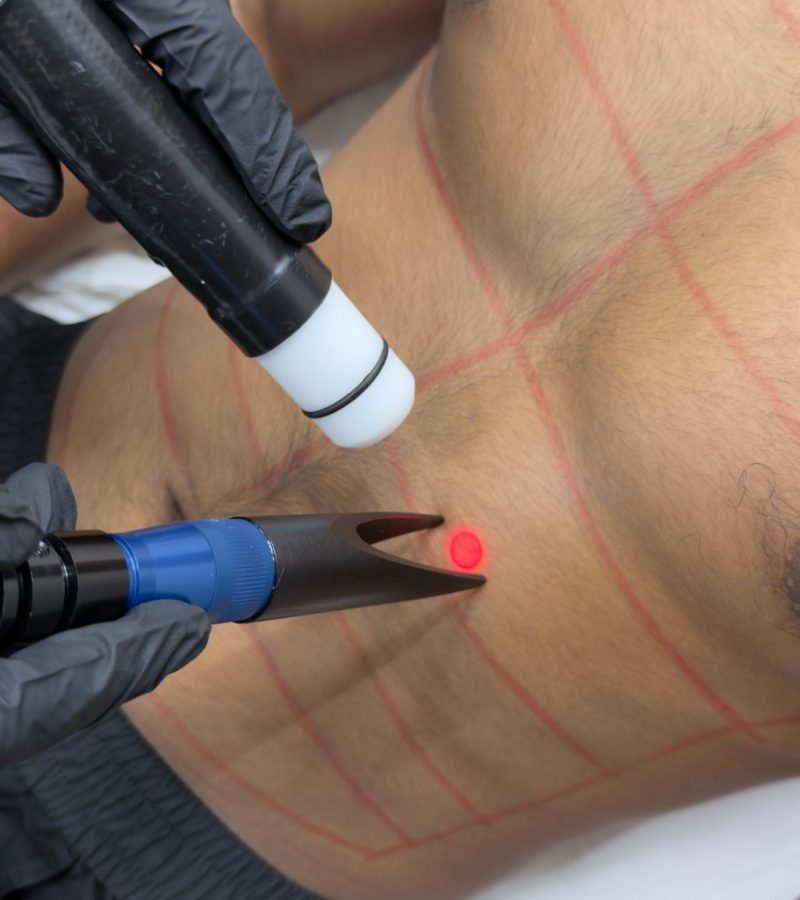
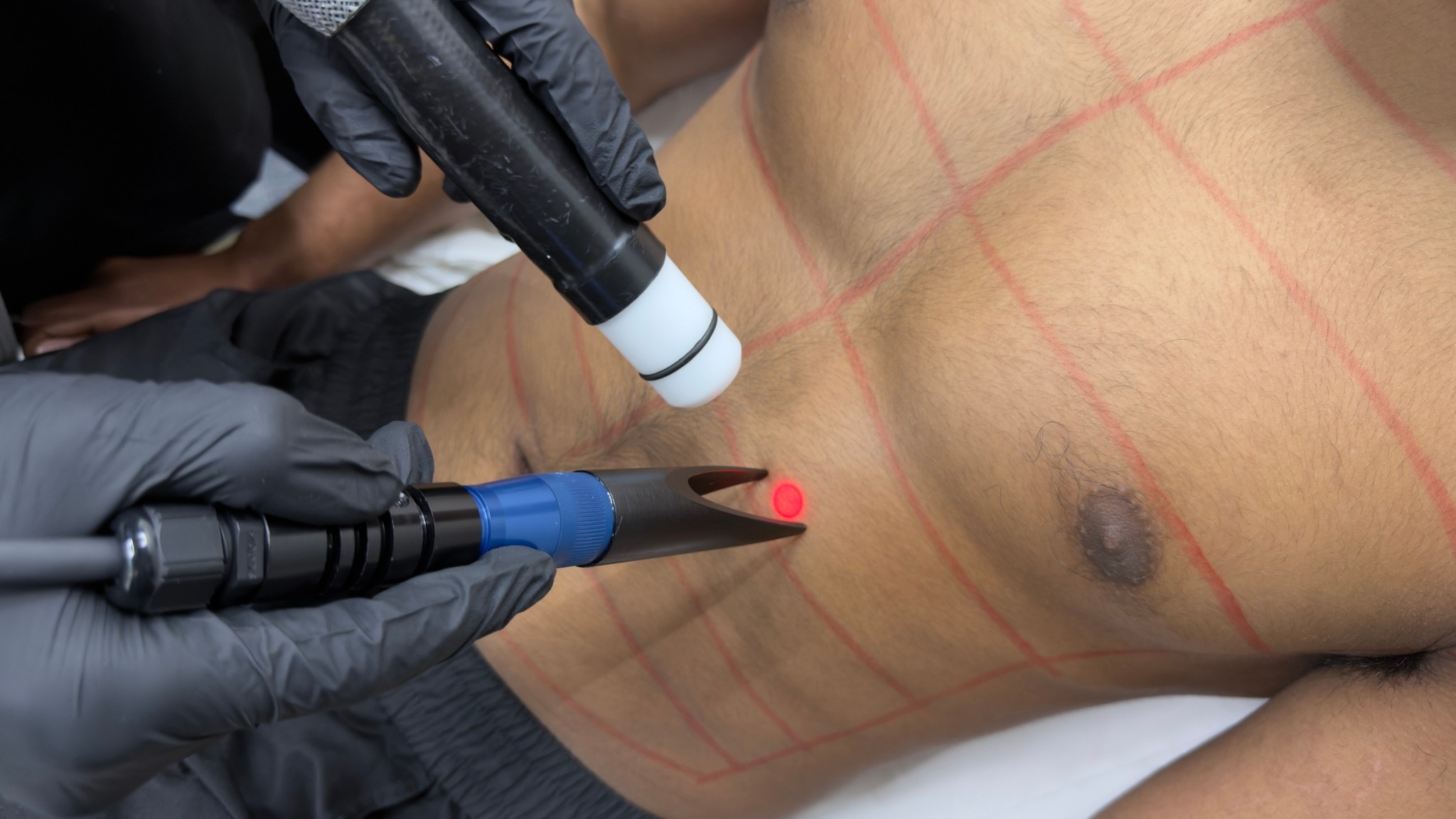
Most men describe the sensation on the chest as a warm snap, similar to a light elastic band flick, followed by a brief cooling sensation from the machine’s built-in cooling system. The chest is generally more tolerable than thinner-skinned areas because there is more coverage over muscle and less bone close to the surface, though sensitivity varies between the sternum, pectorals and collarbone.
A full chest session typically takes around 20 to 30 minutes, depending on hair density and area covered. Clients regularly say that once the first session is done and they know what to expect, the following sessions feel far less daunting, and practitioners talk clients through what is happening rather than working in silence.
Aftercare After Chest Laser Hair Removal
Aftercare for the chest is straightforward but matters for getting a full course right:
- Avoid sun exposure and sunbeds on the treated area for the period advised, using SPF if it will be exposed.
- Avoid hot showers, saunas and intense exercise causing heavy sweating for 24 to 48 hours, as heat and sweat can irritate freshly treated skin.
- Avoid exfoliating products, retinols or perfumed body products on the chest for a few days.
- Mild redness or puffiness around follicles is normal and usually settles within a day.
- Do not wax, pluck or use hair removal cream between sessions. Shaving is fine and the recommended way to manage regrowth.
- Keep to the 4 to 6 week gap between sessions so the next batch of follicles is in the right growth phase.
Common Mistakes Men Make With Chest Laser Hair Removal
- Waxing or plucking between sessions. This removes the hair the laser needs to target and disrupts the growth cycle the course depends on.
- Skipping the patch test. It checks how your skin responds before the whole chest is treated, and skipping it risks an adverse reaction going unnoticed.
- Turning up with a fresh tan. One of the most common reasons a session gets rescheduled, avoidable by planning sessions around holidays, not straight after them.
- Expecting one or two sessions to finish the job. Laser only affects hair in the active growth phase, so a realistic course is 6 to 8+ sessions.
- Assuming results will match a friend’s. Hair colour, density, hormones and skin type all affect outcome, so results vary between individuals.
Chest Laser Hair Removal in Bradford and Oldham
At the Bradford clinic, 73 Godwin Street in Bradford City Centre, chest clients include men travelling from Leeds, Halifax and surrounding West Yorkshire towns for a men only, private appointment away from mixed clinics.
At the Oldham clinic, 99 Huddersfield Road, the newer branch serves men across Greater Manchester who want the same specialist approach without travelling into central Manchester. Both branches run the same consultation, patch test and ND:YAG protocol.
You can call the team on 01274 900256, or book online directly for either branch. For men also considering nearby areas, back laser hair removal and shoulder laser hair removal are commonly booked alongside chest sessions as part of a wider upper body course.
Is Chest Laser Hair Removal Worth It? Our Verdict
For men who shave or wax the chest regularly and deal with irritation, ingrown hairs or daily stubble, chest laser hair removal is generally worth it as a long term reduction in maintenance, provided expectations are realistic and a full course is followed. It is not worth it for men with white, grey, red or very light blonde chest hair, since there is no pigment to target. Our position is that a proper consultation and patch test should always come before any decision, because suitability genuinely depends on the individual, not the marketing.
Book Your Chest Laser Hair Removal Treatment
Ready to find out if you’re suitable? Book online or call 01274 900256 to arrange a consultation and patch test at Bradford or Oldham. See full course pricing on our prices page, or read more on the men’s laser hair removal hub.
FAQs About Chest Laser Hair Removal for Men
Most men need around 6 to 8 sessions, spaced 4 to 6 weeks apart, though coarser or denser chest hair can need more. Spacing allows hair resting during earlier sessions time to enter its active growth phase, which is when laser is effective.
Most clients describe a warm snapping sensation, similar to a light elastic band flick, with cooling used throughout. Pain tolerance varies, but the chest is generally more manageable than thinner-skinned areas.
Yes, chest and shoulders are commonly combined in the same appointment as part of an upper body course. As a men only upper body clinic, lower body and intimate areas are outside what is treated here.
A full chest session typically takes around 20 to 30 minutes, depending on hair density and area covered.
Laser hair removal gives long term hair reduction rather than permanent removal. Most men see significantly less, finer regrowth after a full course, with results varying between individuals.
ND:YAG is generally considered safer for darker Fitzpatrick skin types (IV to VI) than older IPL or alexandrite systems, as it is less absorbed by surface melanin. Suitability is still confirmed through consultation and patch testing, not assumed from skin tone alone.
Avoid intense exercise causing heavy sweating for 24 to 48 hours, along with hot showers and saunas, as heat and sweat can irritate freshly treated skin. Light activity is generally fine.
Yes, shortly before a session so the laser can target the follicle beneath the skin rather than burning hair above it. Your practitioner will confirm exact timing at consultation.
Laser reduces hair growth, it does not even out naturally patchy chest hair, which is often hormonally driven. It can reduce overall density in a way that makes patchiness less noticeable for some men.
Many gym-going clients say a cleaner chest shows muscle definition more clearly under vests and fitted training kit, since hair no longer obscures the outline. This is a cosmetic preference, not a guaranteed change to how muscle appears.
BRADFORD BRANCH
OLDHAM BRANCH