Laser Hair Removal for Men in Their 40s and 50s: What Changes

Age itself is not a barrier to laser hair removal. Nd:YAG laser targets melanin (pigment) in the hair, not the number of birthdays you’ve had, so what actually changes for men in their 40s and 50s is hair pigment (grey and white hairs don’t respond to laser), skin that takes slightly longer to settle after treatment, and a much higher chance of being on regular medication. None of these rule you out. They’re exactly what your consultation and patch test are there to check.
Is Laser Hair Removal Still Effective for Men Over 40?
Yes, in most cases, and the biology explains why. Nd:YAG laser hair removal works by heating the melanin (pigment) inside a hair follicle until the follicle is damaged and future regrowth is reduced. That mechanism doesn’t check your date of birth. It checks how much pigment is sitting in the hair it’s aimed at. A 45-year-old with dark, coarse chest hair and a 25-year-old with dark, coarse chest hair will generally respond in a broadly similar way, because the laser is reacting to the hair, not the man.
What genuinely does shift as men move through their 40s and 50s isn’t the treatment itself, it’s the context around it. We’ll separate what’s a documented fact from what’s a reasonable assumption, because this is exactly where a lot of clinic websites get vague.
Hair Pigment and Grey Hair in Men’s 40s and 50s
Fact. Hair greying is a pigment change, not an age limit. As men move through their 40s and 50s, melanin production in individual hair follicles slows and eventually stops, which is why hair turns grey or white, often starting at the temples and beard-line before spreading to the chest, shoulders and back. This is well documented in dermatological literature and is the single most relevant change for laser hair removal in this age bracket, because Nd:YAG laser has nothing to grip onto once the pigment is gone. The NHS Leeds Teaching Hospitals patient information for laser hair reduction is plain about it: “the laser will not have any effect on white, grey or blonde hair” (Leeds Teaching Hospitals NHS Trust, laser hair reduction).
The practical result for a man in his 40s or 50s is that his laser response depends on how much of his hair has greyed in the treatment area, not on his age as a number. A 48-year-old with a fully dark beard-line and a 58-year-old with the same fully dark beard-line are both good candidates. A 40-year-old whose beard-line has already gone predominantly grey is not, and no amount of extra sessions changes that.
Skin Changes in Men Over 40 and 50
Fact, with a caveat. Skin naturally thins and loses some collagen density from the mid-30s onward, and cumulative sun exposure adds to that over decades. This can mean slightly longer settling time after a session. Assumption, stated honestly as one: we’re not aware of published clinical data specifically quantifying “recovery time by decade” for Nd:YAG hair removal, so we won’t invent a number here. Thinner, more sun-exposed skin is exactly the kind of thing a practitioner checks visually and by touch at consultation and patch test, alongside Fitzpatrick skin type, before agreeing a treatment plan. If you’ve spent 30 years on building sites, on the golf course, or on the beach without sun protection, say so. It’s useful information, not a disqualifier.
Medication Use Rises With Age
Fact. Medication use in the general population is common and rises with age. NHS Digital’s Health Survey for England data shows that 43-44% of men nationally reported taking at least one prescribed medicine in the past week, across all adult age groups combined (NHS Digital, prescribed medicines data). Regular prescribing is well known to increase with age, largely driven by conditions like high blood pressure, high cholesterol and type 2 diabetes becoming more common from the 40s onward. That means a much higher proportion of men booking a consultation in their 40s or 50s will be on some form of regular medication than a man in his 20s. This matters because some medications increase the skin’s sensitivity to light, and that’s a consultation question, not an age question, covered properly below.
Why Men in Their 40s and 50s Start Laser Hair Removal
Assumption, based on general life-stage patterns rather than Alpha-specific data. The reasons a man in his 20s books in are often about starting a new grooming habit early. In our experience in clinic, men in their 40s and 50s more often come in around a specific trigger: a health kick after a wake-up-call birthday, getting back into the gym properly for the first time in years, a wedding where he’s the father of the groom rather than the groom himself, or starting to date again after a divorce or bereavement and feeling self-conscious about back or shoulder hair for the first time in decades. None of this changes the treatment. It does mean the conversation at consultation is often different, and a good practitioner will listen for it.

National Award Winner
Secured top 3 positions across 4 major categories at the Beauty & Aesthetics Awards 2025

Category of
Category of
best for laser award
Category of
best social media
Category of
entrepreneur of the year
Category of
best aesthetics practitioner
Category of
most wanted aesthetic clinic

Category of
RISING STAR
AWARd

Category of
best for laseR Award
Category of
Best Social
Media Award
Category of
Entrepreneur of the year
Category of
Best Aesthetics practitioner

Category of
Most Wanted Aesthetic Clinic
National Award Winner
Secured top 3 positions across 4 major categories at the Beauty & Aesthetics Awards 2025
Category of
RISING STAR
AWARd
Category of
best for laseR Award
Category of
Best Social
Media Award
Category of
Entrepreneur of the year
Category of
Best
Aesthetics practitioner
Category of
Most Wanted Aesthetic Clinic
How Does Laser Hair Removal Work on Grey Hair in Older Men?
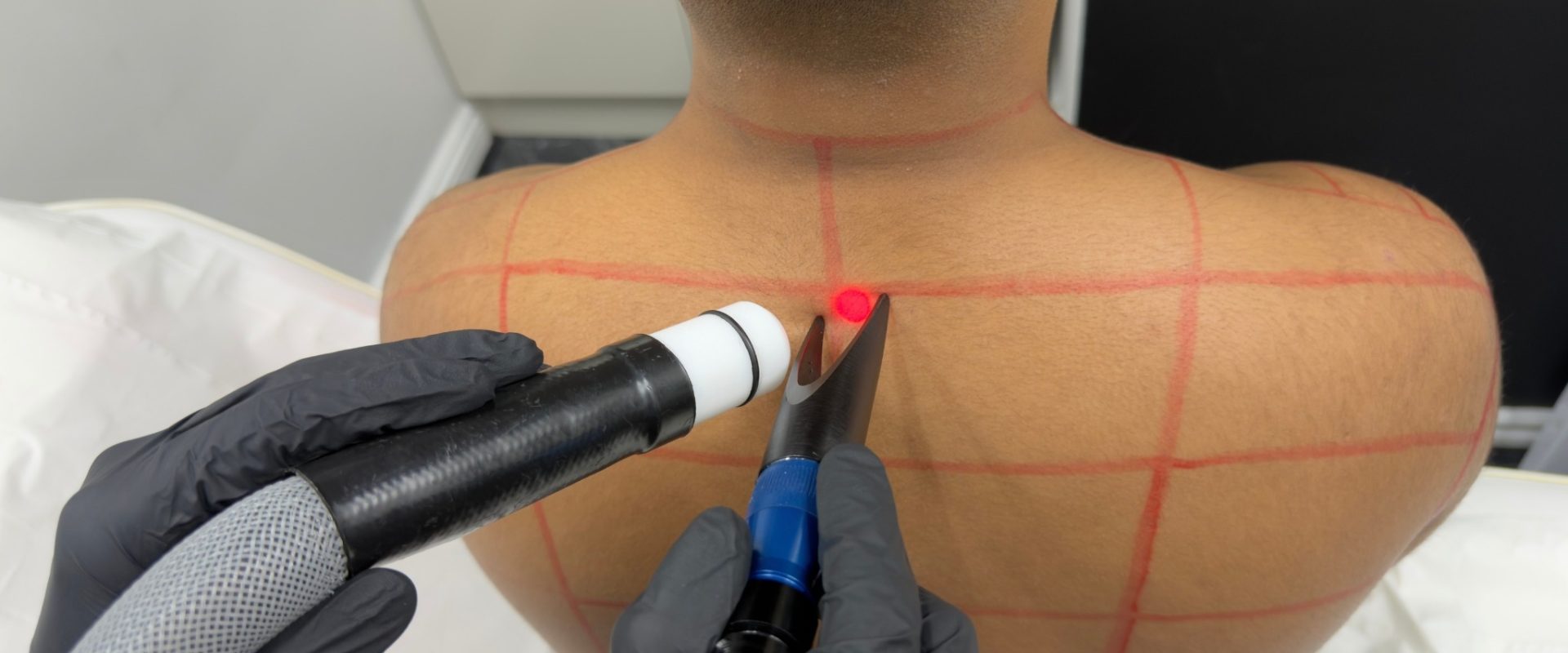
Nd:YAG laser hair removal works on a simple physical principle: the laser fires a beam of light at a specific wavelength, in Alpha’s case 1064nm, which passes through the skin and is absorbed by melanin, the pigment that gives hair its colour. That absorbed light converts to heat, and the heat damages the hair follicle enough to reduce future regrowth. DermNet NZ, a widely used clinical dermatology reference, describes this directly: “light pulses target the hair follicle, which causes the hair to fall out and minimises further growth.”
The 1064nm wavelength Nd:YAG uses is longer than older laser types like Alexandrite, which means it penetrates deeper into the skin and scatters less at the surface. That’s precisely why Nd:YAG is the technology of choice for darker skin tones (Fitzpatrick IV-VI), where shorter wavelengths risk pigment damage to the skin itself. DermNet NZ notes that Nd:YAG is “effective for treating dark (brown/black) hair in patients of Fitzpatrick types I to III, and perhaps light-coloured type IV skin,” while flagging that “extreme caution is recommended in tanned or darker-skinned patients” generally with laser treatment. None of this is age-dependent. It’s entirely about the hair’s pigment and the skin’s pigment, which is why our medical-grade laser technology is built around Nd:YAG specifically.
Here’s the arithmetic that most clinics never show you, because it’s uncomfortable but honest. Picture a chest or beard-line where roughly 70% of the hairs are still dark and 30% have turned grey, a genuinely common pattern for a man in his late 40s or 50s. Session by session, the laser will visibly thin that dark 70%. The grey 30% has little to no melanin for a 1064nm beam to lock onto, so it won’t respond in any meaningful way. After a full course, you’re not looking at a hairless chest. You’re looking at noticeably less dark hair, with the grey hairs still present, roughly the proportion you started with. That’s not a treatment failure. That’s the pigment ceiling, and it’s the same for a 30-year-old with early salt-and-pepper stubble as it is for a 55-year-old with a fully grey beard-line.
This is also exactly why the hair growth cycle matters more than most men realise. Laser only affects hair that’s actively growing (the anagen phase), and hair elsewhere in the cycle is invisible to the laser at that session, which is precisely why one session was never going to be enough, at any age. It’s also why NHS Leeds’s own patient information describes their specific protocol as three treatments, based on their laser type and clinical goal, while private medical-grade Nd:YAG courses, including Alpha’s, typically run to 6-8 or more sessions. The difference reflects the laser, the protocol and the treatment goal, not the client’s age, and it’s a good reason comparing session counts between providers without knowing their laser type is close to meaningless.
Laser Hair Removal Suitability for Men in Their 40s and 50s: The Hair and Skin Matrix
Nobody in this market publishes an honest matrix for this. Here’s ours.
Hair and Skin Scenario | Expected Laser Response | Why | What to Discuss at Consultation |
Fully dark, coarse hair (any age, 20s to 60s) | Good to strong response, visible thinning over a full course | High melanin content gives the 1064nm Nd:YAG beam a strong target | Treatment area, coarseness, and how many sessions your specific hair typically needs |
Salt-and-pepper or greying hair (mixed dark and grey in the same area) | Partial response: visible thinning on the dark hair, little to no change on the grey hair | The laser responds to pigment hair by hair. Dark hairs have melanin to target, grey hairs largely don’t | Setting realistic expectations for the proportion of grey versus dark in your specific area |
Mostly grey or white hair | Little to no response expected | Grey and white hair has minimal to no melanin, so there’s very little for the laser to target regardless of age | Whether electrolysis is a more suitable route for you |
Darker Fitzpatrick skin tones (IV-VI) | Good response achievable, but only with the right laser | Nd:YAG’s longer wavelength reduces the risk of pigment damage to darker skin compared with shorter-wavelength lasers | Confirming Nd:YAG (not Alexandrite or IPL) is being used, and any history of hyperpigmentation |
Thinner or sun-damaged skin (common after decades of sun exposure) | Treatable in most cases, may need a more cautious settings approach | Skin condition affects how it absorbs and responds to laser energy, independent of the client’s age in years | Sun exposure history, current tan status, and any skin conditions in the treatment area |
Your practitioner will confirm exactly where you sit on this at consultation using a visual and physical assessment, not a guess from a form. That’s the entire point of the six-month laser hair removal timeline being built around your actual hair and skin, not a generic script.
Is Laser Hair Removal Safe for Men Over 40 on Regular Medication?
For most men on most common medications, yes, but this is genuinely the question that deserves the most honesty on this page, so we’ll take it slowly.
Some medications increase the skin’s photosensitivity, meaning skin reacts more strongly to light, including laser light, than it normally would. NHS Leeds patient information is direct about this: “taking certain prescription medications (for example, those that increase the skin’s sensitivity to sunlight) may mean that you cannot be treated” (Leeds Teaching Hospitals NHS Trust). We won’t hand you a definitive list of banned drugs here, because getting that wrong in either direction would be worse than saying nothing. What we can point to, from real NHS guidance, is a pattern: NHS advice on acne treatment notes that benzoyl peroxide “makes your face more sensitive to sunlight,” that topical retinoids require you to “avoid excessive exposure to sunlight and UV,” and that tetracycline antibiotics “can make your skin sensitive to sunlight and UV light” (NHS, acne treatment). Those are common, everyday prescriptions, and a man in his 40s or 50s dealing with adult acne, rosacea, or a short antibiotic course is statistically more likely to be on one than a man in his 20s.
Blood pressure medication and statins, the two medication types most associated with this age bracket, aren’t generally flagged as photosensitising in the same way, but that’s exactly why we don’t guess. It’s assessed properly, individually, at consultation.
This is precisely why Alpha’s consultation and patch test process includes direct medication questions before any treatment plan is agreed, and why patch testing exists at all: it’s a real, physical check of how your specific skin responds, on this specific day, rather than a generic assumption based on your age or your prescription list alone. Tell your practitioner about all medications you’re taking, prescribed or over-the-counter, including anything you’ve started recently. They will assess whether you’re suitable, and if there’s any doubt, they’ll say so rather than proceed and hope.
Laser Hair Removal for Men in Their 40s and 50s: Real Scenarios
Numbers are one thing. Here’s how this actually plays out for real men in this bracket.
Laser Hair Removal for a 48-Year-Old Starting a Health Kick
He’s just joined the gym properly for the first time in a decade, dropped two stone, and is suddenly spending far more time in changing rooms and fitted training kit than he has in years. His chest and back hair is fully dark, thick, and has never been treated. This is close to a best-case profile: dark, coarse hair responds well to Nd:YAG regardless of the fact he’s 48, not 28. The constraint isn’t his age, it’s his gym schedule, since he’ll need to plan around the 7-day no-swimming, no-sauna window after each session, which for a man who’s just fallen in love with the pool and steam room again is the one thing worth planning ahead for.
Laser Hair Removal for a 52-Year-Old on Daily Blood Pressure Medication
He’s been on the same blood pressure tablet for six years, feels completely well on it, and assumed that being “on medication” at 52 might automatically rule him out. It doesn’t automatically rule him out. Common blood pressure medications aren’t typically flagged as photosensitising in NHS guidance in the way certain acne treatments or antibiotics are, but “typically” isn’t good enough on its own. The honest answer is that his practitioner reviews his specific medication and health history at consultation before agreeing any plan, and a patch test confirms how his skin actually responds. He’s not treated based on an assumption either way.
Laser Hair Removal for a 45-Year-Old Father of the Groom
He wants to look sharp for his son’s wedding, not for himself twenty years ago, for a specific date on a specific calendar. This is where the timeline arithmetic actually matters. If the wedding is 10 weeks away and he wants visibly less shoulder and neck hair for the photos, a single session isn’t going to deliver that, because laser only affects hair in the anagen phase at the time of treatment, and a proper course needs multiple sessions spaced 4-6 weeks apart. The honest advice here is to start as early as possible, ideally 6+ months out, and treat a wedding as a milestone within an ongoing course rather than the reason to start one two weeks before.
Laser Hair Removal for a 50-Year-Old Man Back on the Dating Scene
After a divorce, he’s dating again for the first time in over two decades, and back hair he’d stopped thinking about entirely is suddenly something he notices before taking his shirt off. This is a genuinely common, rarely discussed reason men in this age bracket start laser hair removal, and there’s nothing unusual or embarrassing about it. His hair is salt-and-pepper, mostly dark with visible grey through it. Per the matrix above, he’ll see real, visible thinning on the dark portion and should expect the grey hairs to remain, which is worth knowing before he starts so the result matches what he was actually told to expect.
Who Laser Hair Removal Isn’t Right For, Whatever Your Age
Be specific with yourself here, because a clinic that won’t be specific with you isn’t being honest with you either.
Laser hair removal is not the right treatment, at any age, for a man whose hair in the treatment area has gone predominantly grey or white. This isn’t about being 45 versus being 65. It’s about pigment. If your beard-line, chest or back hair is mostly grey now, Nd:YAG has very little to work with, and no realistic number of sessions changes that fact. Electrolysis, which works by damaging the follicle directly with an electric current rather than relying on pigment absorption, is the honest alternative here, and we’ll cover it properly in the next section.
Laser hair removal also isn’t right, at least not immediately, for anyone with active sunburn or a fresh tan on the treatment area, anyone currently on a photosensitising medication without a proper consultation review first, and anyone hoping for a guarantee of permanent hair removal. Results vary between individuals, and the honest term is long-term hair reduction, not permanent removal (read more on whether laser hair removal is permanent). If any of this applies to you, say so at consultation. A practitioner who tells you “not yet” or “not this area” is doing their job properly, not turning away business for no reason.
Common Mistakes Men in Their 40s and 50s Make With Laser Hair Removal
Assuming grey hair will respond the way it used to when it was dark. If your beard-line was fully dark five years ago and has since gone salt-and-pepper, don’t expect the same visible result you might have seen a decade earlier. The hair that’s greyed genuinely won’t respond in the same way, and going in expecting otherwise just sets you up for disappointment that isn’t the clinic’s fault or yours, it’s pigment.
Not disclosing medication at consultation because it feels irrelevant. A lot of men don’t think to mention a statin, a blood pressure tablet, or a short course of antibiotics because they don’t connect it to skin treatment. Mention everything. It takes thirty seconds and it’s exactly what protects you.
Expecting the same session count as a mate with fully dark hair. Session count depends on hair colour, coarseness, treatment area and how your specific skin and hair respond, not on comparing notes with a friend who has a completely different hair type. Your consultation and patch test are exactly where this gets assessed properly for you, not guessed at generically from someone else’s course.
Leaving it too late before an event. A wedding, a milestone birthday holiday, or a return to the dating scene often prompts men in this bracket to book, but a full course realistically needs 6-8+ sessions spaced 4-6 weeks apart, which adds up to roughly 6-12 months depending on gaps and rebooking. Starting two months before a big date means you’ll see the start of a change, not the result you were picturing. Start as early as you can and treat the event as a point along the course, not the deadline for finishing it.
Laser Hair Removal Services For Men In Bradford
Alpha Laser Clinic is Yorkshire’s first men’s only clinic specialising in men’s laser hair removal in Bradford and other cosmetic treatments for all skin tones.
Laser Hair Removal vs Electrolysis vs Shaving for Older Men: Which Should You Choose?
We’d rather point you to the right option, including ones we don’t offer, than pretend laser is the answer for every hair type.
Option | Works on Grey/White Hair? | Typical Longevity | Best For | Trade-off |
Nd:YAG laser hair removal (Alpha) | No, needs pigment in the hair | Long-term hair reduction over a full course, results vary between individuals | Men with substantially dark hair wanting less shaving and fewer shaving bumps | Requires 6-8+ sessions spaced weeks apart, and won’t touch grey or white hair |
Electrolysis | Yes, works regardless of hair colour | Considered the only genuinely permanent hair removal method | Men whose treatment-area hair has gone predominantly grey or white | Treats hair one follicle at a time, so slower per session and priced accordingly |
Shaving or trimming | Not applicable | Days, needs constant repetition | Any hair colour, zero upfront cost or commitment | Shaving bumps, irritation and ingrown hairs, especially with thick or curly hair |
Waxing | Not applicable | A few weeks per session | Men wanting a longer gap between hair removal than shaving | Can be uncomfortable on larger areas like the back and chest, regrowth returns fully |
For a man in his 40s or 50s with mostly dark hair, Nd:YAG laser hair removal remains the most practical route to less regular shaving and fewer shaving bumps, backed by qualified practitioners, a medical-grade Nd:YAG laser, and a proper consultation and patch test process. For a man whose hair has gone predominantly grey or white in the treatment area, we’ll say so honestly and point you toward electrolysis rather than take a course of sessions that won’t deliver a visible result.
Is Laser Hair Removal Worth It for Men in Their 40s and 50s? Our Honest Verdict
Our verdict: age itself is not a barrier to laser hair removal, and we’d say that to a 25-year-old and a 55-year-old in exactly the same words. What actually determines whether it’s worth it for you is your hair’s pigment (dark hair responds, grey and white hair doesn’t), your skin (assessed properly at consultation, not guessed from your date of birth), and your medication (disclosed honestly so your practitioner can assess it rather than assume either way). If your hair in the treatment area is still substantially dark, laser hair removal is very likely to be a genuinely useful option for less shaving, fewer shaving bumps, and easier grooming, whether you’re 28 or 58. If it’s gone mostly grey, we’d rather tell you that upfront and point you to electrolysis than sell you a course that won’t show the result you’re picturing. That’s what consultation and patch testing are actually for, and it’s why we don’t skip straight to treatment on a first visit.
Alpha’s Google and Trustpilot reviews reflect the consultation-led approach rather than a rushed, one-size-fits-all script. As one client, Zain Malik, put it in a Google review: “AC and Shoqeeb always look after me. I only wish I started laser a lot sooner. Professional with the best machine going and even give a bespoke consultation before each session to make sure any line up or removal is exactly to your liking.” Another, Qasim Hussain, wrote: “I have been visiting Alpha for over a year now for some treatments and from the first appointment to now the guys have been excellent. This is definitely the best male laser clinic out there.” These reviews don’t reference the reviewer’s age, and we’re not using them to claim an age-specific result. They’re a general trust signal on how consultations and treatment are actually run, which is the part of this decision that matters most whatever bracket you’re in.
Laser Hair Removal for Men in Their 40s and 50s FAQ
Q1 Does laser hair removal work differently on men in their 40s and 50s?
The treatment itself works the same way at any age, because Nd:YAG laser targets melanin in the hair, not the number of birthdays you’ve had. What changes is context: hair is more likely to have some grey through it, skin may take slightly longer to settle, and medication use is more common. None of that rules you out, it just makes an honest consultation more important.
Q2 Is laser hair removal safe for men over 40?
Generally yes, for men whose treatment-area hair is still substantially dark and who don’t have a specific contraindication such as active sunburn, a fresh tan, or an unreviewed photosensitising medication. Safety is assessed individually through consultation and patch testing, not assumed from age alone.
Q3 Does grey hair respond to laser hair removal?
No, not meaningfully. Grey and white hair has little to no melanin, and Nd:YAG laser needs melanin to target. This is a pigment fact confirmed by both DermNet NZ and NHS patient information, and it applies at any age. If your hair has gone mostly grey in the treatment area, electrolysis is the honest alternative.
Q4 Can I have laser hair removal if I’m on blood pressure medication or statins?
Possibly, and this is exactly what your consultation is for. Common blood pressure and cholesterol medications aren’t typically flagged as photosensitising in the way some acne treatments and antibiotics are, but every medication is reviewed individually at consultation before any treatment plan is agreed. Always disclose everything you’re taking.
Q5 How many laser hair removal sessions do men in their 40s and 50s need?
There’s no separate age-based session count. Most courses run to 6-8 or more sessions spaced roughly 4-6 weeks apart, because laser only affects hair in its active growth phase at the time of treatment, and hair grows in cycles. Your practitioner will confirm your personal treatment plan at consultation based on your hair and skin, not your age.
Q6 Does laser hair removal hurt more as you get older?
There’s no reliable evidence that pain perception during laser hair removal changes specifically with age. Sensation is generally described as a brief heat or snapping feeling and varies by treatment area and individual pain tolerance far more than by decade of life.
Q7 What medications should I mention before laser hair removal?
Mention everything: prescribed medication, recent courses of antibiotics, acne treatments such as retinoids or benzoyl peroxide, and anything bought over the counter. NHS guidance notes that some acne treatments and tetracycline antibiotics increase sun sensitivity, and your practitioner needs the full picture to assess you properly rather than guess.
Q8 Is laser hair removal permanent for men over 40?
No treatment provider can honestly promise permanent hair removal at any age. The realistic, evidence-based term is long-term hair reduction, and results vary between individuals depending on hair and skin type, consistency of sessions, and aftercare. Read more on whether laser hair removal is permanent.
Q9 What’s the alternative to laser hair removal if my hair has gone grey?
Electrolysis is the main alternative, because it damages the hair follicle directly with an electric current rather than relying on light being absorbed by pigment, so it works regardless of hair colour. It’s typically slower per session than laser and priced accordingly, but it’s the honest route for hair that’s gone predominantly grey or white.
Q10 Where can men in their 40s and 50s get laser hair removal in Bradford or Oldham?
Alpha Laser Clinic offers men-only Nd:YAG laser hair removal at both branches: Bradford, at 73 Godwin Street, Bradford City Centre, BD1 2SH, and Oldham, at 99 Huddersfield Road, OL1 3NQ. Both are open Monday to Sunday, 11am to 9pm, and every course starts with a proper consultation and patch test, whatever your age.
Book a Laser Hair Removal Consultation in Bradford or Oldham
If your hair in the treatment area is still substantially dark, age isn’t what’s holding you back, and a proper consultation will tell you exactly where you stand rather than leave you guessing. Book a consultation online or call the Bradford clinic on 01274 900256 to ask any question honestly, including the awkward ones, before you commit to anything.




